Provides fast, repeatable control
A piston actuator switches between fully open and fully closed positions in far less time than a motorized electric actuator; preferred in automation cycles that run frequently.
Product group · Valve Group
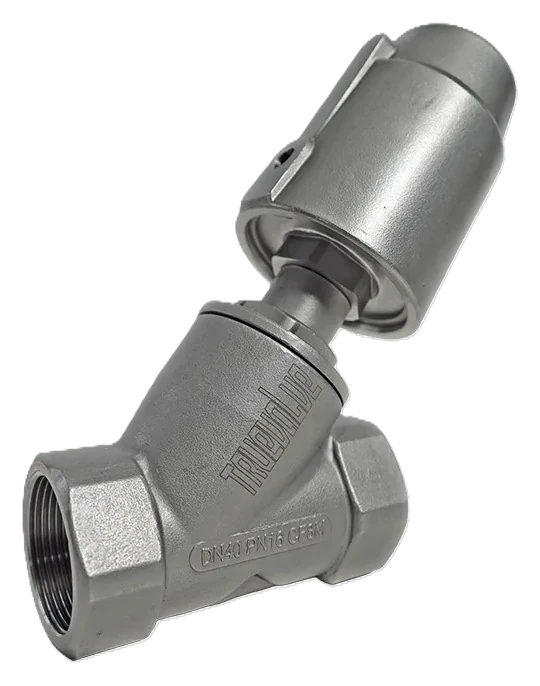
Pneumatic piston-actuated valves are created by adding a compressed-air-driven piston actuator to a butterfly, ball or globe valve body; they open and close quickly and repeatably in response to a signal from the automation system. Single-acting (spring-return) models bring the valve to a safe position when air is cut off. As Denfor Endüstriyel, we supply double-acting and single-acting (fail-safe) pneumatic piston-actuated valves together with positioner and solenoid valve equipment.
Why it matters
A compressed-air-driven piston actuator enables valves to be operated quickly and reliably from the automation system.
A piston actuator switches between fully open and fully closed positions in far less time than a motorized electric actuator; preferred in automation cycles that run frequently.
In single-acting models, when air is cut off the spring automatically brings the valve to a predetermined safe position (open or closed), protecting process safety during a power or air supply failure.
Fitted with a solenoid valve and a positioner, it connects to the PLC/SCADA system, offering remote monitoring and control.
The piston mechanism is simple with few moving parts; with the right air quality (dried, filtered) it runs for years with little maintenance.
Types
All three are operated by compressed air; what sets them apart is the actuator type and the valve body.
Both the opening and closing movements are driven by compressed air; preferred on lines that cycle frequently and where it is not a problem to remain in whatever position they were in during a power/air failure.
One of the opening or closing directions is driven by spring force; when air is cut off, the valve automatically returns to the safe position.
With a positioner added, this modulating type can stop at intermediate positions and is used for flow/temperature control.
Selection criteria
Selection can't be made without the first two points. The rest determine the actuator type and equipment.
Line diameter
Determined by the nominal diameter of the existing pipeline.
DN size
Valve body type
Whether the actuator will be fitted to a butterfly, ball or globe body.
Butterfly / ball / globe
Position desired on air loss
Whether fail-safe open, fail-safe closed, or staying in its last position.
Open / closed / last position
Control type
Whether on-off only, or intermediate-position control is required.
On-off / proportional
Supply air pressure
The actuator is sized to match the existing installation's air pressure.
bar
Equipment needed
Whether a solenoid valve, positioner or limit switch is required.
Solenoid / positioner / limit switch
It's fine if you don't have all of it. We'll fill in the gaps together with you.
Create a quote requestFAQ
The questions we hear most often when quoting pneumatic piston-actuated valves.
In a double-acting actuator, both the opening and closing movements are driven by compressed air; in a single-acting (spring-return) actuator, one direction is driven by air and the other by spring force, and when air is cut off the valve automatically returns to the safe position.
A fail-safe model should be preferred on lines where it is critical for process safety that the valve stay in a defined position (open or closed) during a power or air supply failure, such as on safety shutoff valves.
A pneumatic actuator responds faster than an electric motorized actuator and can be used more easily in explosion-risk environments without requiring additional certification; however, it requires a compressed air infrastructure on site.
It transmits the valve's instantaneous opening position to the automation system as a 4-20 mA signal, providing feedback for both monitoring and proportional control applications.
No. While our office is on Istanbul's Anatolian side (Ataşehir), we supply and ship across Istanbul's European side, the surrounding provinces and the Marmara region, and Turkey as a whole — covering your equipment end to end, from a single source.
Next step
Share your line diameter and the safe position you want on air loss, and let's determine the right pneumatic piston-actuated valve for your line together.
Related products
Complementary equipment you may need for your project.