Provides precise flow control
Because the disc moves perpendicular to the seating surface, it creates a stable, adjustable flow cross-section even at intermediate positions; the erosion risk seen in gate valves is not a concern here.
Product group · Valve Group
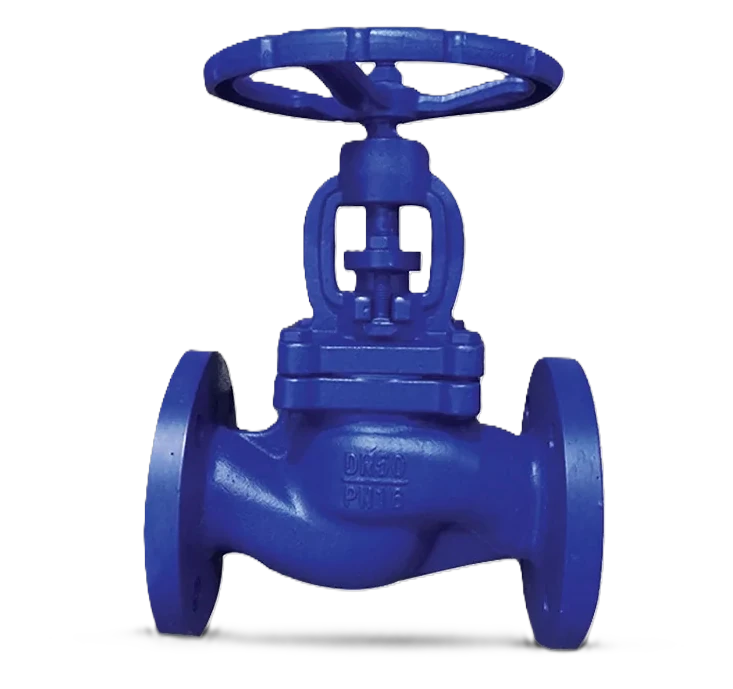
Globe valves are control valves in which the fluid changes direction inside a globe-shaped body, operated by moving a disc-shaped closing element perpendicular to its seating surface. This change of direction in the flow path enables precise flow control, but causes higher pressure loss than a gate valve. As Denfor Endüstriyel, we supply globe valves in straight, angled and angled-elbow body types, matched to the flow-control needs of steam, water and process lines.
Why it matters
Thanks to precise positioning between the disc and the seating surface, unlike a gate valve it can be reliably used for flow control.
Because the disc moves perpendicular to the seating surface, it creates a stable, adjustable flow cross-section even at intermediate positions; the erosion risk seen in gate valves is not a concern here.
Contact between the disc and the seating surface provides consistent sealing in both the control and full-shutoff positions.
Depending on line layout and flow direction, you can choose from straight-through, 45°/90° angled, or angled-elbow body types.
Precise positioning can be achieved in the field using a handwheel, or via a pneumatic/electric actuator connected to the automation system.
Types
All three work on the disc-seat principle; what sets them apart is body geometry and flow direction.
The most commonly used standard body type, where the fluid enters along a straight axis and changes direction in an S-shape.
Used in line layouts with a 45° or 90° angle between inlet and outlet, without needing a separate elbow fitting; pressure loss is lower than the standard type.
Fitted with an electric or pneumatic actuator and a positioner, it is used as a precise flow/temperature control valve connected to the automation system.
Selection criteria
Selection can't be made without the first two points. The rest determine the body type and control method.
Line diameter
Determined by the nominal diameter of the existing pipeline.
DN size
Pressure class
The PN class is chosen to match the line's operating pressure.
PN16 / 25 / 40
Fluid type and temperature
Determines the disc and gasket material.
°C + fluid type
Intended use
Shutoff only, or precise flow control.
Shutoff / flow control
Line layout
Whether a straight or angled body type suits the layout.
Straight / angled
Control method
Whether a manual valve or an actuated control valve is wanted.
Manual / actuated
It's fine if you don't have all of it. We'll fill in the gaps together with you.
Create a quote requestFAQ
The questions we hear most often when quoting globe valves.
A gate valve offers almost no resistance to flow when fully open and is intended only for on/off use; a globe valve, on the other hand, operates stably at intermediate positions, allowing precise flow control, but it causes a certain pressure loss even when fully open.
Because the fluid changes direction in an S-shape inside the valve, it experiences more pressure loss compared with the straight-through path of a gate valve; this is the trade-off that comes with precise control.
Fitted with an electric or pneumatic actuator and a positioner, the globe valve operates at a partial opening in response to a signal from the automation system, keeping temperature or flow rate at the desired value.
If the pipeline already has a 45° or 90° change of direction, an angle-bodied globe valve can be used without needing a separate elbow fitting, providing both space and pressure-loss advantages.
No. While our office is on Istanbul's Anatolian side (Ataşehir), we supply and ship across Istanbul's European side, the surrounding provinces and the Marmara region, and Turkey as a whole — covering your equipment end to end, from a single source.
Next step
Share your line diameter and flow-control needs, and let's determine the right globe valve for your line together.
Related products
Complementary equipment you may need for your project.