Absorbs thermal expansion
The elongation and contraction that temperature changes cause in the pipeline are absorbed by the expansion joint's flexible structure; stress on the line and connected equipment is prevented.
Product group · Valve Group
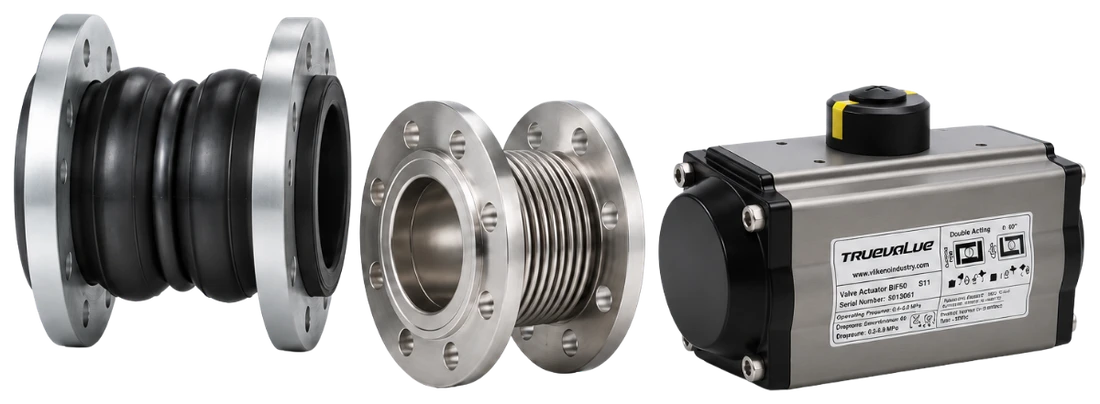
Expansion joints absorb the pipe elongation caused by temperature changes and equipment vibration, preventing stress on the line. Actuators, in turn, allow valves to be operated remotely, either electrically or pneumatically. As Denfor Endüstriyel, we supply bellows-type and rubber expansion joints, and electric and pneumatic actuators, selected according to line diameter, movement capacity and control type.
Why it matters
One absorbs thermal movement and vibration in the pipeline, the other enables valves to be operated remotely and automatically.
The elongation and contraction that temperature changes cause in the pipeline are absorbed by the expansion joint's flexible structure; stress on the line and connected equipment is prevented.
Expansion joints fitted at the outlet of vibration-source equipment such as pumps and compressors reduce the transmission of vibration to the pipeline and the structure.
Electric or pneumatic actuators allow valves that are hard to access in the field, or that need frequent operation, to be opened and closed remotely from the automation system.
The expansion joint type (bellows/rubber) and the actuator type (electric/pneumatic) are determined together, based on the line's diameter, the expected amount of movement, and the control requirement.
Types
Types covering two different functions: expansion joints that absorb movement/vibration, and actuators that provide valve control.
With a stainless steel bellows construction, it absorbs axial, lateral or angular movement on high-temperature and high-pressure lines.
With a flexible rubber/composite construction, it is more effective at vibration damping than the bellows type in particular; widely used at pump outlets.
Mounted on the valve, it provides on-off or proportional control remotely or from the automation system; the electric type offers precise positioning, the pneumatic type a fast response.
Selection criteria
Selection can't be made without the first two points. The rest determine the type and equipment.
Line diameter
Determined by the nominal diameter of the existing pipeline.
DN size
Need type
Whether expansion/vibration absorption, or valve control, is required.
Expansion joint / actuator
Movement amount and direction
The amount of axial, lateral or angular movement, for expansion joint selection.
mm + direction
Operating temperature and pressure
Affects whether a bellows-type or a rubber expansion joint is chosen.
°C + bar
Control type (for actuators)
Whether electric or pneumatic, and on-off or proportional, is wanted.
Electric / pneumatic
Existing valve/equipment size
The connection size of the valve the actuator will be fitted to.
DN size + connection type
It's fine if you don't have all of it. We'll fill in the gaps together with you.
Create a quote requestFAQ
The questions we hear most often when quoting expansion joints and actuators.
A bellows-type (metal) expansion joint is preferred on high-temperature and high-pressure lines, while a rubber expansion joint is preferred at pump/compressor outlets where vibration damping is the priority.
An electric actuator offers more precise positioning and easy wiring; a pneumatic actuator responds faster and can be more economical if a compressed air infrastructure already exists on site.
It is generally installed at pump/compressor outlets, in the middle of long straight pipe runs, and at expansion zones between fixed points; verification with a project-specific static calculation is recommended.
Most butterfly and ball valves are suitable for retrofitting an actuator with a matching connection flange; the right actuator is selected by checking the existing valve's connection size and torque requirement.
No. While our office is on Istanbul's Anatolian side (Ataşehir), we supply and ship across Istanbul's European side, the surrounding provinces and the Marmara region, and Turkey as a whole — covering your equipment end to end, from a single source.
Next step
Share whether your need is an expansion joint or an actuator, and your line diameter, and let's determine the right equipment together.
Related products
Complementary equipment you may need for your project.