The heart of heating and cooling circuits
It keeps water continuously circulating in the closed circuit — the one moving link between the exchanger, boiler, calorifier or fan coil and the points of use.
Product group · Flow Transfer Products
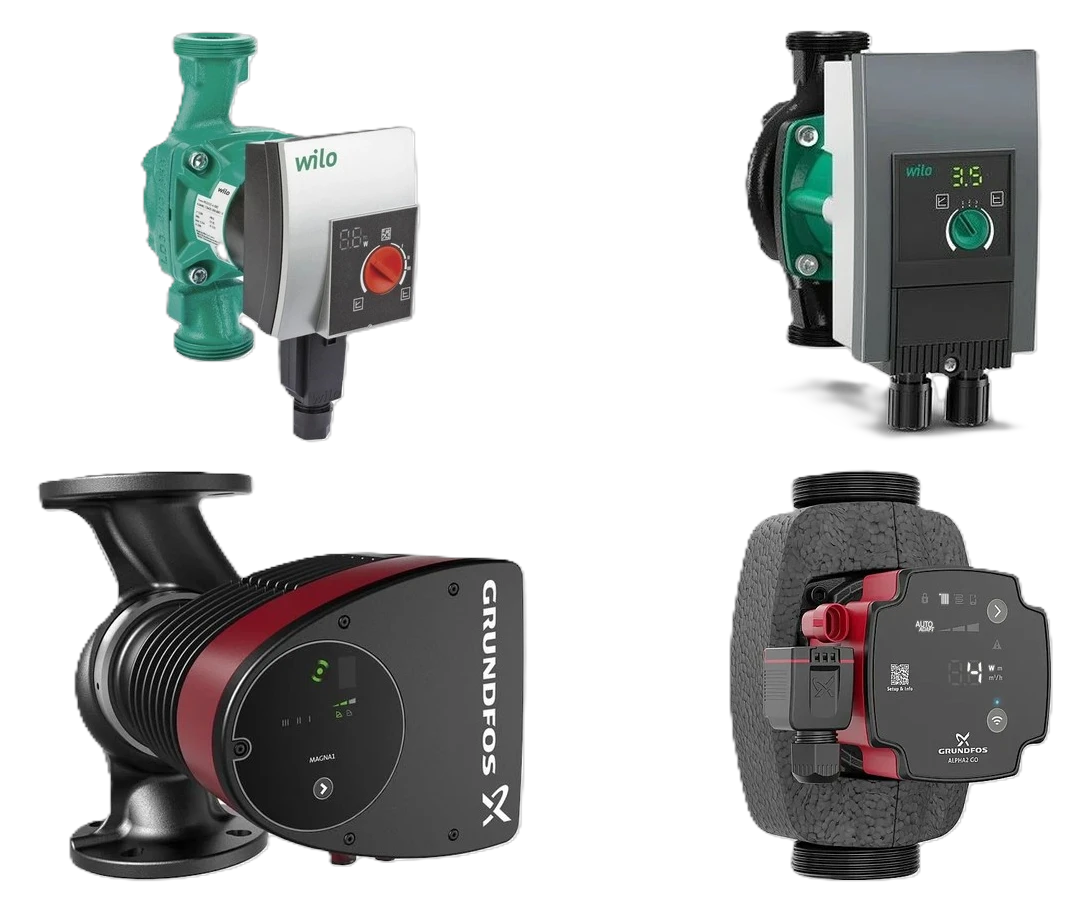
Compact pumps mounted directly on the pipeline that keep water continuously circulating through closed-circuit heating and cooling systems. Available in wet- or dry-rotor, single- or twin-head types; frequency-controlled models adjust speed to the system's instantaneous demand, cutting energy use noticeably.
Why it matters
It keeps water continuously circulating in the closed circuit — the one moving link between the exchanger, boiler, calorifier or fan coil and the points of use.
It keeps water continuously circulating in the closed circuit — the one moving link between the exchanger, boiler, calorifier or fan coil and the points of use.
Models that automatically adjust speed to system demand make a noticeable difference in the annual electricity bill, since consumption drops with the cube of the speed.
Wet-rotor types have no mechanical shaft seal, which means quiet operation and less maintenance.
On critical lines, twin-head pumps back each other up; while one is under maintenance, the system keeps running without interruption.
Types
All three circulate water in the closed circuit; what sets them apart is the rotor design and head configuration.
The rotor turns inside the fluid, with no mechanical shaft seal; it runs quietly, needs little maintenance, and is the standard solution for residential and commercial heating/cooling circuits.
The motor is separated from the fluid by a mechanical shaft seal; preferred on industrial lines that need higher flow rate and head.
Houses two pumps in a single casing; while one runs, the other stands by or alternates in — preferred on lines that require uninterrupted operation.
Selection criteria
Without the first two points, selection cannot be made. The rest determine the model and fittings.
Flow rate
Calculated from heating/cooling capacity and temperature difference.
m³/h
Head
The installation's total resistance: pipe friction and fitting losses. If undersized, the flow rate will not be met.
mWC
Fluid type and temperature
Water or a glycol mixture. Glycol raises viscosity; more power is needed for the same flow rate.
Fluid + °C + % ratio
Rotor type (wet/dry)
Determines the flow-pressure range, noise level and maintenance preference together.
Wet / dry rotor
Operating regime
Constant flow, or variable? For variable loads, a frequency-controlled model should be chosen from the start.
Constant / variable
Connection size and mounting location
Flanged/threaded connection size, shaft height and service clearance.
DN size + mounting clearance
It's fine if you don't have all of it. We'll fill in the gaps together with you.
Create a quote requestFAQ
The questions we hear most often when quoting circulation pumps.
Wet-rotor pumps run quietly and need little maintenance; they are sufficient for most residential and commercial heating-cooling circuits. For higher flow rate or head, or for high-temperature/process applications, the dry-rotor type is preferred.
No. On lines with a constant load, the extra cost may not pay back. On variable-flow systems and fan coil circuits, however, it usually pays for itself quickly.
On critical lines that must run without interruption; if one head fails or is under maintenance, the other automatically takes over and the system does not stop.
We can, but it is often not the best choice. The old pump was either wrong from the start, or the installation has changed since then. We can take the nameplate data and supply the same model; with a short check, we can also tell you whether it is really operating at the right point.
No. While our office is on Istanbul's Anatolian side (Ataşehir), we supply and ship across Istanbul's European side, the surrounding provinces and the Marmara region, and Turkey as a whole — covering your equipment end to end, from a single source.
Next step
Share the flow rate and head, and let's determine together the right circulation pump for your heating or cooling circuit.
Related products
Complementary equipment you may need for your project.