Prevents backflow and water hammer
When the pump stops or power is cut, the check valve closes instantly, preventing the fluid from flowing back and the resulting water hammer damage.
Product group · Valve Group
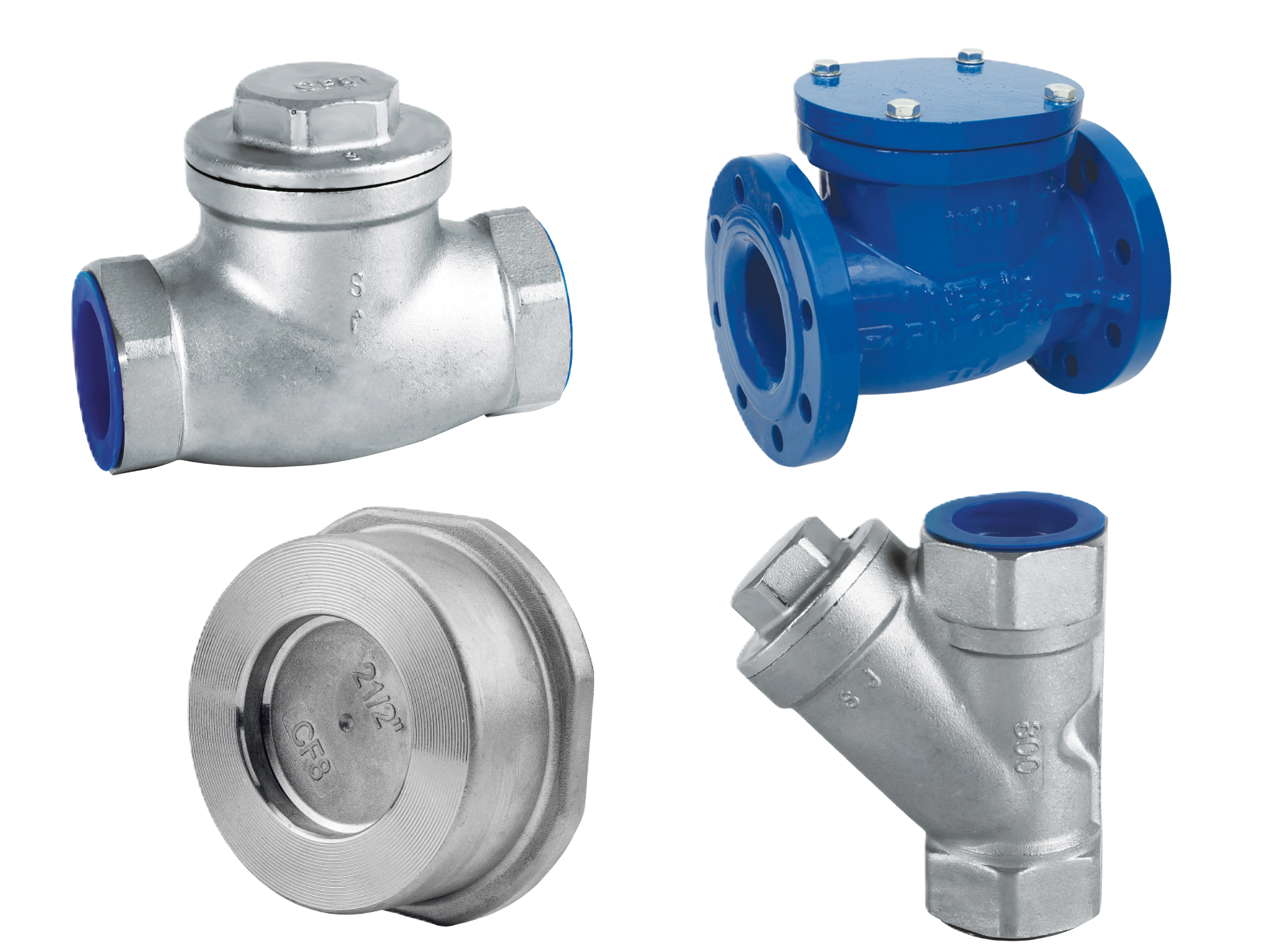
Check valves allow fluid to flow in only one direction, preventing backflow when the pump stops or pressure reverses; they protect pumps from water hammer and reverse rotation. Strainers, in turn, hold solid particles in the line on a screen, protecting pumps, valves and measuring instruments from wear and clogging. As Denfor Endüstriyel, we supply spring-loaded, swing-check and wafer-type check valves, and Y-type and basket-type strainers, matched to line diameter and mesh size.
Why it matters
One protects the pump by preventing backflow, the other holds back solid particles to prevent equipment wear and clogging.
When the pump stops or power is cut, the check valve closes instantly, preventing the fluid from flowing back and the resulting water hammer damage.
Without a check valve, fluid flowing back can turn the pump rotor in reverse; this can damage the pump shaft and mechanical seal.
Solids in the line, such as sand, rust particles or welding debris, are held on the screen before they can reach the pump, valve or heat exchanger.
Basket or Y-type strainers can be cleaned by removing the bottom cap, without dismantling the line; this simplifies periodic maintenance.
Types
Three types covering two different functions: check valves that prevent backflow, and strainers that hold back solids.
Closes instantly by spring or weight action the moment the fluid stops; the standard check valve type used at pump outlets.
A light, economical check valve type without its own flange, clamped between two pipe flanges; preferred on lines with limited space.
Holds solid particles in the line on a screen, protecting pumps, valves and measuring instruments; the basket type offers a higher holding capacity, the Y-type a more compact design.
Selection criteria
Selection can't be made without the first two points. The rest determine the type and equipment.
Line diameter
Determined by the nominal diameter of the existing pipeline.
DN size
Equipment type
Whether a check valve, a strainer, or both are required.
Check valve / strainer / both
Check valve type
Spring-loaded, swing-check or wafer type, matched to line layout.
Spring-loaded / swing-check / wafer
Strainer type and mesh size
Y-type/basket-type and mesh selection, based on particle size in the fluid.
Y / basket + mesh size
Pressure class
Must match the line's operating pressure.
PN class
Connection size and installation location
Flange size and installation clearance.
DN size + installation clearance
It's fine if you don't have all of it. We'll fill in the gaps together with you.
Create a quote requestFAQ
The questions we hear most often when quoting check valves and strainers.
It is usually installed at the pump outlet, matched to the flow-direction arrow marked on it; this way, backflow is blocked instantly when the pump stops.
It depends on how dirty the fluid is; on newly commissioned lines or lines right after welding, frequent cleaning is recommended in the first weeks, then according to a periodic maintenance schedule.
The Y-type is more compact and suits both horizontal and vertical lines; the basket type has a higher holding capacity and is preferred on lines with heavy fouling.
It is determined by the maximum particle size the protected equipment (pump, valve, measuring instrument) can tolerate; a finer mesh may require more frequent cleaning.
No. While our office is on Istanbul's Anatolian side (Ataşehir), we supply and ship across Istanbul's European side, the surrounding provinces and the Marmara region, and Turkey as a whole — covering your equipment end to end, from a single source.
Next step
Share your line diameter and the equipment you want to protect, and let's determine the right check valve or strainer for your line together.
Related products
Complementary equipment you may need for your project.