Suited to fluids with solids and fibers
The sharp-edged gate plate closes the flow passage by cutting through buildup and fibers; it works reliably in fluids such as wastewater, pulp and sludge where conventional valves clog.
Ürün grubu · Vana Grubu
Knife gate valves work by a sharp-edged gate plate closing directly through the flow passage. In fluids containing solids, fibers and sludge, the gate cuts through the buildup to achieve a complete shutoff — a solution for lines where conventional valves clog. As Denfor Endüstriyel, we supply single- and bidirectional-sealing knife gate valves, with manual, pneumatic and electric actuator options, matched to line diameter and fluid type.
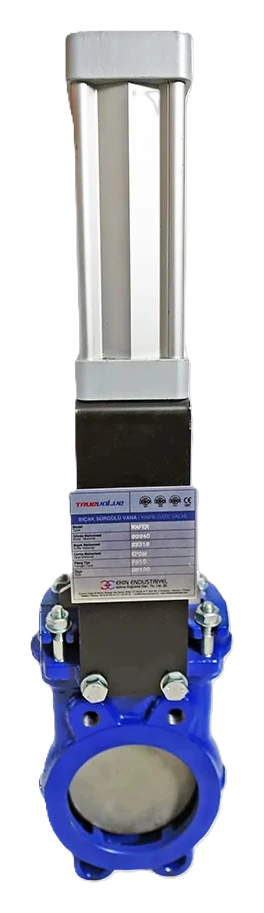
Why it matters
It achieves a complete shutoff on lines where conventional valves clog, in fluids containing solids, fibers and sludge.
The sharp-edged gate plate closes the flow passage by cutting through buildup and fibers; it works reliably in fluids such as wastewater, pulp and sludge where conventional valves clog.
The gate closes by physically cutting through solids built up in the line, which eliminates the risk of staying half-open or leaking.
A single- or bidirectional-sealing type is chosen depending on whether the flow needs to be sealed in one direction or both.
It can be operated manually in the field, or via a pneumatic or electric actuator connected to the automation system.
Types
All three close with a sharp gate; what sets them apart is the sealing direction and body material.
The economical standard choice for lines where a fully sealed shutoff in one flow direction is sufficient.
Used on lines where pressure direction can change and the flow must be fully sealed in both directions.
Built with a stainless steel body and gate instead of cast iron, for corrosive fluids or processes that require hygiene.
Selection criteria
Selection isn't possible without the first two items. The rest determine the sealing direction and operation type.
Line diameter
Determined by the nominal diameter of the existing pipeline.
DN size
Fluid type
Solids ratio and fiber content determine the gate and gasket material.
Wastewater / sludge / fiber, etc.
Sealing direction
Whether the flow must be fully shut off in one direction or both.
Single direction / bidirectional
Body material
Cast or stainless is chosen based on a corrosive fluid or hygiene requirement.
Cast / stainless
Operation type
Whether manual or a pneumatic/electric actuated model is wanted.
Manual / actuated
Connection size and mounting location
Flange size and installation clearance.
DN size + mounting clearance
Hepsi olmasa da olur. Eksik kalanları sizinle birlikte tamamlarız.
Create a quote requestFAQ
The questions we hear most often when quoting knife gate valves.
A butterfly valve is used for line shutoff in clean fluids; a knife gate valve solves clogging problems in fluids containing solids and fibers, because its gate cuts through the buildup to achieve a complete shutoff.
On lines where the flow direction can change with the process, or pressure can come from either side, a single-direction model cannot provide adequate sealing, so the bidirectional type is preferred.
It is used in almost every industry that carries fluids containing solids or fibers, such as wastewater treatment, pulp and paper, mining, cement and sugar production.
If the fluid contains a corrosive chemical, or the process is food/chemical and requires hygiene, a stainless steel body and gate should be chosen instead of cast iron.
No. While our office is on Istanbul's Anatolian side (Ataşehir), we supply and ship across Istanbul's European side, the surrounding provinces and the Marmara region, and Turkey as a whole — covering your equipment end to end, from a single source.
Next step
Share your line diameter and fluid type, and we'll work out the right knife gate valve for your line together.
Related products
Complementary equipment you may need for your project.