The most common pump type in industry
Thanks to its simple operating principle, wide capacity range and easy availability, it is the first choice for water and process-liquid transfer.
Product group · Flow Transfer Products
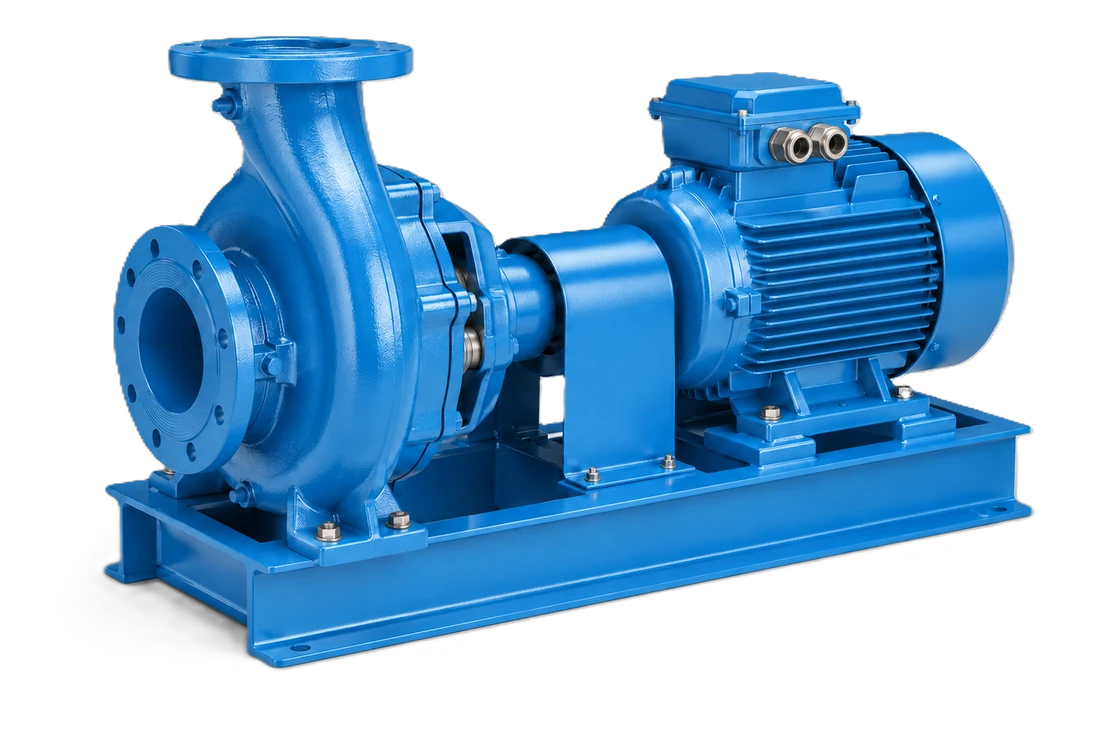
Centrifugal pumps use a rotating impeller to accelerate the fluid, delivering it at high flow rate. Thanks to their simple operating principle and wide capacity range, they are the most widely used pump type in industrial facilities; supplied in monobloc, split-casing and inline types, with material options suited to water, process-liquid and chemical-fluid applications.
Why it matters
It is the standard solution for water transmission, irrigation and process-liquid transfer lines that need high flow rate.
Thanks to its simple operating principle, wide capacity range and easy availability, it is the first choice for water and process-liquid transfer.
It covers a very wide range of flow rate and head — from small circulation lines to large water transmission lines — with a single pump family.
Because standard parts and seal options are widely available, a fault gets a fast response and service support.
With stainless steel, cast iron or specially coated casing options, it also offers a suitable solution for process liquids other than water.
Types
All three accelerate the fluid with a rotating impeller; what sets them apart is the casing design and mounting style.
The motor and pump casing are a single piece; its compact build takes up little space, and it is common on residential and commercial circulation/water transmission lines.
The motor and pump casing are separated by a coupling; preferred on industrial lines needing high flow rate and head, with the advantage of easy maintenance.
Inlet and outlet share the same axis; it mounts directly on the pipeline and is used on circulation and process lines where installation space is limited.
Selection criteria
Without the first two points, selection cannot be made. The rest determine the material and casing type.
Flow rate
Calculated from the line's hourly or instantaneous demand.
m³/h
Head
Calculated from the installation's total resistance and elevation difference.
mWC
Fluid type
Water, a process liquid or a chemical; chemical compatibility determines the material.
Fluid type
Operating temperature
The seal and gasket material are chosen based on temperature.
°C
Casing material
Cast iron, stainless or a special coating; depends on how corrosive the fluid is.
Cast iron / stainless / coated
Connection size and mounting type
Determined by the choice of monobloc, split or inline mounting.
DN size + mounting type
It's fine if you don't have all of it. We'll fill in the gaps together with you.
Create a quote requestFAQ
The questions we hear most often when quoting centrifugal pumps.
For low-to-medium capacity lines that need a compact installation, monobloc is sufficient. For industrial lines expecting high flow rate/head and frequent maintenance, the split type is more suitable.
Depending on the fluid's pH, temperature and corrosiveness, a stainless steel, special alloy or coated casing is chosen; the label or safety data sheet (SDS) clarifies this choice.
The available pressure at the pump's suction line (NPSHa) must be kept higher than the pressure the pump requires (NPSHr); keeping the suction line short and of a generous cross-section reduces cavitation risk.
Today, most industrial centrifugal pumps use a mechanical seal, which seals better; packed seals are seen more in older or lower-cost applications.
No. While our office is on Istanbul's Anatolian side (Ataşehir), we supply and ship across Istanbul's European side, the surrounding provinces and the Marmara region, and Turkey as a whole — covering your equipment end to end, from a single source.
Next step
Share the flow rate, head and the fluid to be pumped, and let's determine together the right centrifugal pump for your line.
Related products
Complementary equipment you may need for your project.