Pulsation-free, smooth flow profile
The fixed-volume cavities between the rotor and stator advance the fluid with a continuous, smooth profile, providing stability in process dosing.
Product group · Flow Transfer Products
Progressive cavity (helical rotor / eccentric screw) pumps are positive-displacement pumps that advance fluid smoothly and without pulsation through fixed-volume cavities formed as a rotor turns inside a flexible stator. They provide reliable flow rate with high-viscosity, particulate or corrosive fluids (sludge, wastewater, dense chemicals), and are supplied in standard or hygienic casing options.
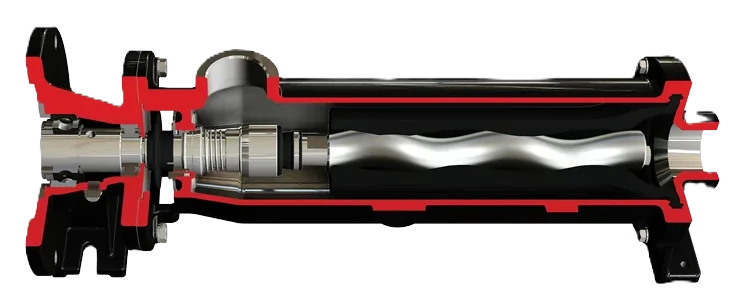
Why it matters
It works where other pump types fall short — with sludge, wastewater and very high-viscosity fluids.
The fixed-volume cavities between the rotor and stator advance the fluid with a continuous, smooth profile, providing stability in process dosing.
Thanks to its wide passage cross-section and positive-displacement design, it conveys sludge and high solids-content fluids without clogging.
With the right elastomer and rotor coating selected, it offers a long service life with corrosive chemicals and wastewater.
The rotor and stator are the main wearing parts; replacing them restores the pump to its original performance.
Types
All three operate on the helical rotor-stator principle; they differ in casing hygiene and pressure capacity.
The standard solution for wastewater treatment and sludge transfer lines, tolerant of high solids content.
With stainless casing and food-grade elastomers, used for the hygienic transfer of viscous food and cosmetic products.
Generates high pressure with additional rotor-stator stages; used for long-distance sludge or process transfer.
Selection criteria
Selection cannot be made without the first two items. The rest determine the stator elastomer and casing type.
Flow rate
Calculated from the demand of the process or wastewater line.
m³/h
Pressure
Determined by line resistance and transfer distance.
bar
Viscosity/particle size
Determines the rotor-stator clearance and passage cross-section.
cSt / particle size
Chemical compatibility of the fluid
The stator elastomer (NBR/EPDM/Viton) is selected based on this data.
Chemical type
Temperature
Affects the temperature resistance of the elastomer material.
°C
Connection type
Preference for flanged, clamp or threaded connection.
Connection standard
It is fine if you do not have all of it. We will fill in the rest together with you.
Create a quote requestFAQ
The questions we encounter most often during the mono pump quotation stage.
It is preferred for fluids that challenge other pump types, such as wastewater sludge, high-viscosity process liquids, particulate food products and corrosive chemicals.
The stator elastomer is in continuous contact with the fluid and wears over time; it is checked periodically and replaced together with the rotor when needed.
Yes, the stator elastomer can heat up quickly and be damaged when run dry; dry-run protection or level control is recommended.
The rotor and stator are supplied as standard spare parts; maintenance is generally limited to removing and replacing these two components.
No. While our office is on Istanbul's Anatolian side (Ataşehir), we supply and ship across Istanbul's European side, the surrounding provinces and the Marmara region, and Turkey as a whole — covering your equipment end to end, from a single source.
Sıradaki adım
Share your fluid's viscosity, solids content and flow rate requirement, and let's determine the right mono pump for your line together.
Related products
Projenizde ihtiyaç duyabileceğiniz tamamlayıcı ekipmanlar.