The fluid touches only the hose — no contamination risk
Parts such as the valve, seal or rotor never touch the fluid, which eliminates the risk of cross-contamination.
Product group · Flow Transfer Products
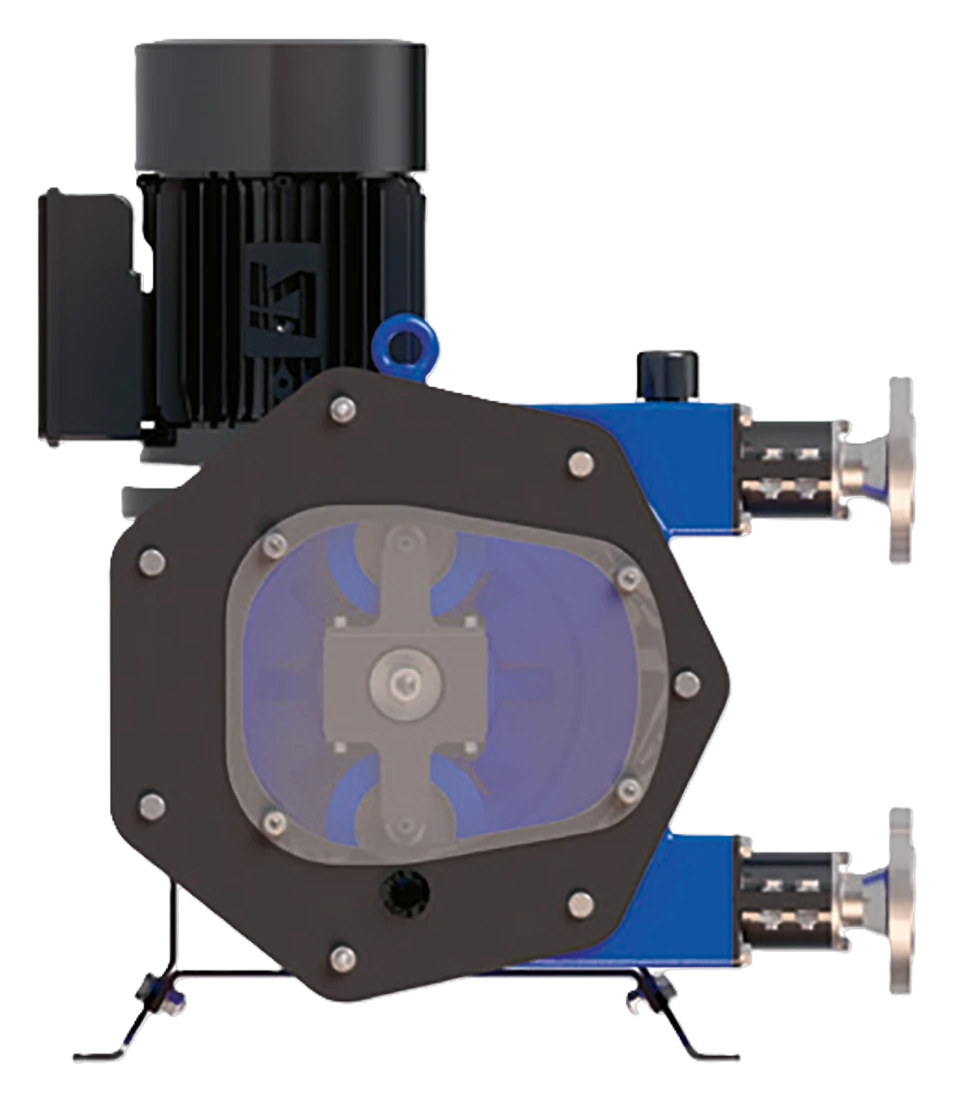
Peristaltic (hose) pumps are positive-displacement pumps where rollers on a rotating rotor squeeze a flexible hose to move the fluid, which never touches the pump casing. They are preferred for corrosive chemicals, sludge and precise dosing applications, for their tolerance of dry running and self-priming.
Why it matters
It is preferred on lines where the fluid must not touch the pump casing, or where dry running is expected.
Parts such as the valve, seal or rotor never touch the fluid, which eliminates the risk of cross-contamination.
The pump is not damaged when the tank runs empty; it can also draw in air-entrained liquid, with no extra protective equipment needed.
The hose is the only wearing part; no valve, seal or gasket maintenance is needed, which lowers maintenance time and cost.
When the hose material is matched to the fluid, it runs on corrosive or particle-laden fluids without risk of clogging.
Types
All three carry fluid by squeezing the hose; what sets them apart is duty weight and flow precision.
An economical, widely used solution for low-to-medium-flow dosing and general liquid transfer.
With a thicker-walled hose and a strong drive, it carries corrosive sludge, waste and high-solids fluids.
Gives high repeatability at low flow rates for laboratory and process dosing applications.
Selection criteria
Without the first two points, selection cannot be made. The rest determine the hose material and size.
Flow rate
Calculated from the demand of the process or dosing line.
m³/h or L/h
Pressure
Hose wall thickness and rotor size are determined from line resistance.
bar
Hose material
An elastomer such as NR, NBR or EPDM is chosen based on the fluid's chemical compatibility.
Elastomer type
Fluid corrosiveness/particle content
Determines hose life and rotor type.
Corrosiveness level
Operating regime
Whether it runs continuously or intermittently affects hose life.
Continuous / intermittent
Connection size
The suction/discharge line's diameter.
DN size
It's fine if you don't have all of it. We'll fill in the gaps together with you.
Create a quote requestFAQ
The questions we hear most often when quoting peristaltic pumps.
It varies with the fluid's corrosiveness, pressure and run time; it typically needs periodic replacement every few months to a year.
It is preferred for corrosive chemicals, sludge, high-solids-content fluids and contamination-sensitive dosing applications, where the fluid must not touch the casing.
The pump is not damaged when the tank runs empty or air gets mixed in, with no extra protective equipment or sensor needed.
Since the hose is the only wearing part, no valve or seal removal and refitting is needed; the hose is replaced quickly.
No. While our office is on Istanbul's Anatolian side (Ataşehir), we supply and ship across Istanbul's European side, the surrounding provinces and the Marmara region, and Turkey as a whole — covering your equipment end to end, from a single source.
Next step
Share the fluid to be pumped and your flow-rate requirement, and let's determine together the right peristaltic pump for your line.
Related products
Complementary equipment you may need for your project.