Chemical dosing at ±1% accuracy
Thanks to adjustable stroke length and frequency, it gives repeatable dosing accuracy even at very low flow rates.
Product group · Flow Transfer Products
Dosing pumps are positive-displacement pumps that add a chemical or additive to a process line at an adjustable, precise and repeatable flow rate. Supplied for water treatment, boiler-room chemical dosing and process lines, with diaphragm or piston drive options, suited to PLC/automation integration.
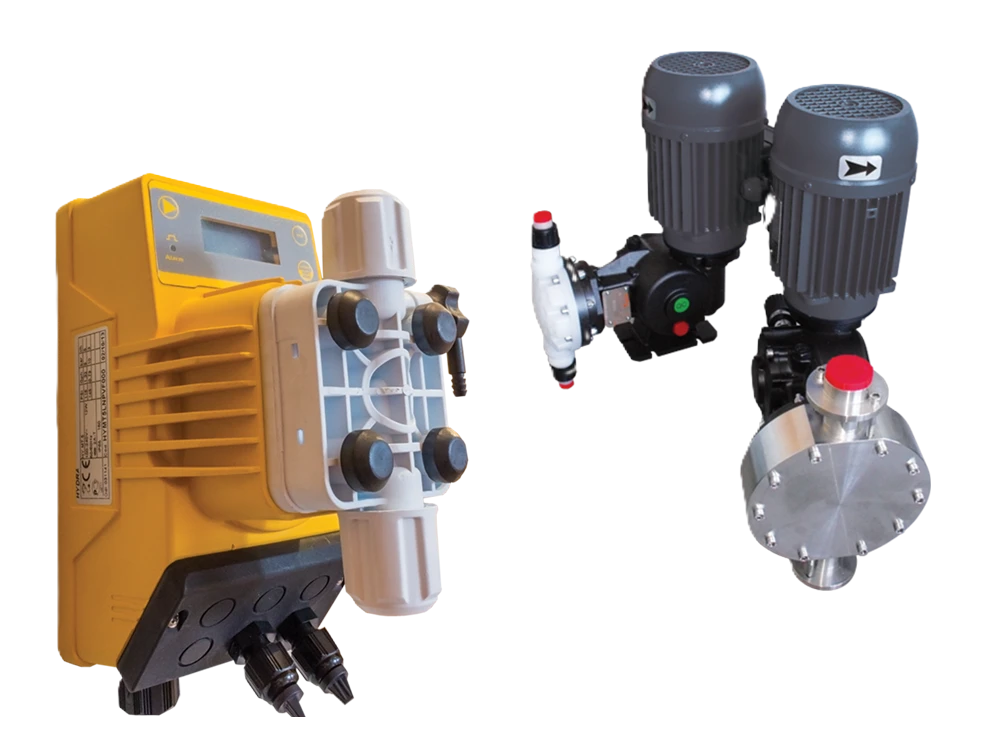
Why it matters
It adds the chemical to the process line in the right amount and at a stable flow rate.
Thanks to adjustable stroke length and frequency, it gives repeatable dosing accuracy even at very low flow rates.
With analog/digital input signals, automatic dosing control tied to process parameters (pH, flow rate, chlorine, etc.) can be implemented.
With PVDF, PP or stainless wetted-end options, it runs safely with acid, chlorine and other corrosive chemicals.
With manual or automatic stroke adjustment, the dosing amount can be quickly readjusted when the process condition changes.
Types
All three add the chemical at an adjustable dose; what sets them apart is the drive mechanism and pressure capacity.
An economical, widely used solution for low-to-medium-flow chemical dosing; commonly used in water treatment and pool disinfection.
With a mechanical motor drive, it offers higher flow rate and pressure capacity; preferred on continuously running process lines.
On process lines that need high pressure, the piston's volumetric motion gives precise, high-pressure dosing.
Selection criteria
Without the first two points, selection cannot be made. The rest determine the material and control type.
Flow range
The minimum and maximum dosing demand range.
L/h (min-max)
Pressure
The process line's back pressure.
bar
Chemical corrosiveness
Determines the wetted-end material (body, gasket, valve).
Chemical type + concentration
Dosing accuracy
The repeatability needed, based on process tolerance.
± %
Control type
Manual, analog signal, or PLC/automation integration.
Manual / automatic
Connection and mounting location
Suction/discharge line size and mounting position.
Connection size
It's fine if you don't have all of it. We'll fill in the gaps together with you.
Create a quote requestFAQ
The questions we hear most often when quoting dosing pumps.
Being able to adjust stroke length and frequency independently gives repeatable, accurate dosing even at low flow rates; calibration should be checked regularly.
Acids, bases, chlorine compounds, flocculants and various process additives; the wetted-end material (PVDF, PP, stainless) is chosen based on how corrosive the chemical is.
Yes, with analog (4-20mA) or digital signal inputs, automatic dosing control tied to a process parameter (pH, ORP, flow rate) can be set up.
The diaphragm and valves are checked periodically; calibration is redone when wear affecting dosing precision is noticed, and the interval depends on how corrosive the chemical is.
No. While our office is on Istanbul's Anatolian side (Ataşehir), we supply and ship across Istanbul's European side, the surrounding provinces and the Marmara region, and Turkey as a whole — covering your equipment end to end, from a single source.
Next step
Share the chemical to be dosed and the flow range, and let's determine together the right dosing pump for your process.
Related products
Complementary equipment you may need for your project.