Designed for CIP/SIP cleaning
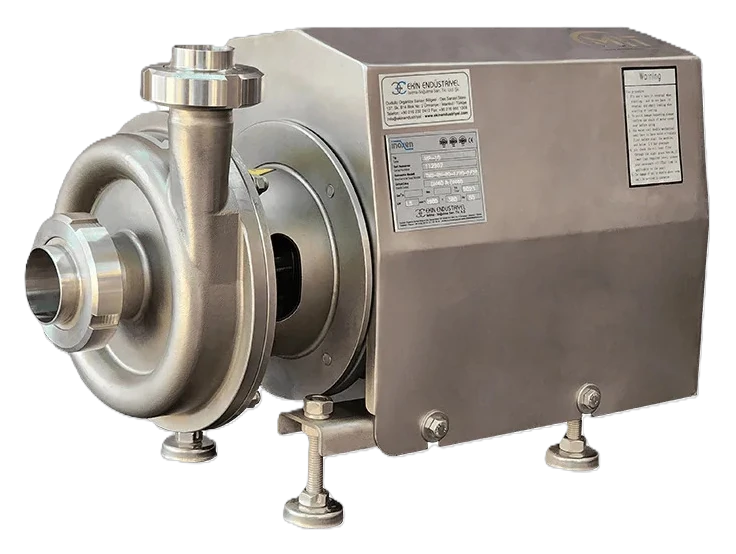
Internal flow is designed to leave no dead zones; it can be cleaned and sterilized in place without removing it from the circuit.
Product group · Flow Transfer Products
Hygienic centrifugal pumps are centrifugal pumps built with an AISI 316L stainless casing, a smooth interior surface and CIP/SIP (clean/sterilize-in-place) compatibility, for use in food, beverage and pharmaceutical processes. They can be quickly fitted to and removed from the process line via Clamp or DIN 11851 connections, and are supplied with food-grade gasket materials.
Why it matters
It provides hygiene and traceability on product-contact lines in food, beverage and pharmaceutical processes.
Internal flow is designed to leave no dead zones; it can be cleaned and sterilized in place without removing it from the circuit.
With an AISI 316L casing and food-grade gaskets, it is used safely in processes that require a hygiene certification.
The electropolished interior surface minimizes product residue sticking and bacterial growth.
Self-priming models can also carry air-entrained liquid on tank drain and CIP return lines.
Types
All three are built with a hygienic casing; what sets them apart is the priming behavior and temperature resistance.
The standard solution for transferring low-to-medium-viscosity food products — milk, fruit juice, beverages — between process lines.
It can also draw in air-entrained liquid when draining tanks and process lines; preferred on CIP return lines.
Built with gasket and material options resistant to the high temperatures (typically 95-140°C) reached during CIP/SIP.
Selection criteria
Without the first two points, selection cannot be made. The rest determine the material and certification requirements.
Flow rate
Calculated from the process line's hourly transfer demand.
m³/h
Head
Determined by line resistance and the inlet pressure of the process equipment.
mWC
Fluid viscosity/particle content
The smooth impeller design suits a specific viscosity range.
cSt / particles present?
Temperature (process + CIP/SIP)
The process temperature and the peak temperature during cleaning are evaluated separately.
°C
Surface roughness and certification
The Ra value and the required hygiene certification (EHEDG/3-A or similar) are determined.
Ra µm + certification
Connection type
Preference for Clamp, DIN 11851 or threaded connection.
Connection standard
It's fine if you don't have all of it. We'll fill in the gaps together with you.
Create a quote requestFAQ
The questions we hear most often when quoting hygienic centrifugal pumps.
CIP (Clean-in-Place) and SIP (Sterilize-in-Place) are in-place chemical cleaning and steam sterilization processes carried out without dismantling the equipment. A pump casing designed to leave no dead zones, together with heat-resistant gaskets, handles this cycle without issue.
Depending on the project, compliance with EHEDG or 3-A design principles may be required; casing material and surface roughness are determined accordingly.
Thanks to its molybdenum content, 316L is more resistant than 304 to chlorinated cleaning chemicals and acidic products; 316L is usually preferred for food and pharmaceutical processes.
Depending on the product's oil/acid content and CIP temperature, a food-grade elastomer is chosen from options such as EPDM, FKM (Viton) or FDA-approved silicone.
No. While our office is on Istanbul's Anatolian side (Ataşehir), we supply and ship across Istanbul's European side, the surrounding provinces and the Marmara region, and Turkey as a whole — covering your equipment end to end, from a single source.
Next step
Share the product to be pumped, the flow rate and your CIP/SIP conditions, and let's determine together the right hygienic pump for your process.
Related products
Complementary equipment you may need for your project.