Prevents short-cycling
A boiler or chiller starts and stops frequently when it cannot cover the load with too little water volume; a buffer tank breaks this cycle by increasing the system's volume.
Product group · Pressure Vessels
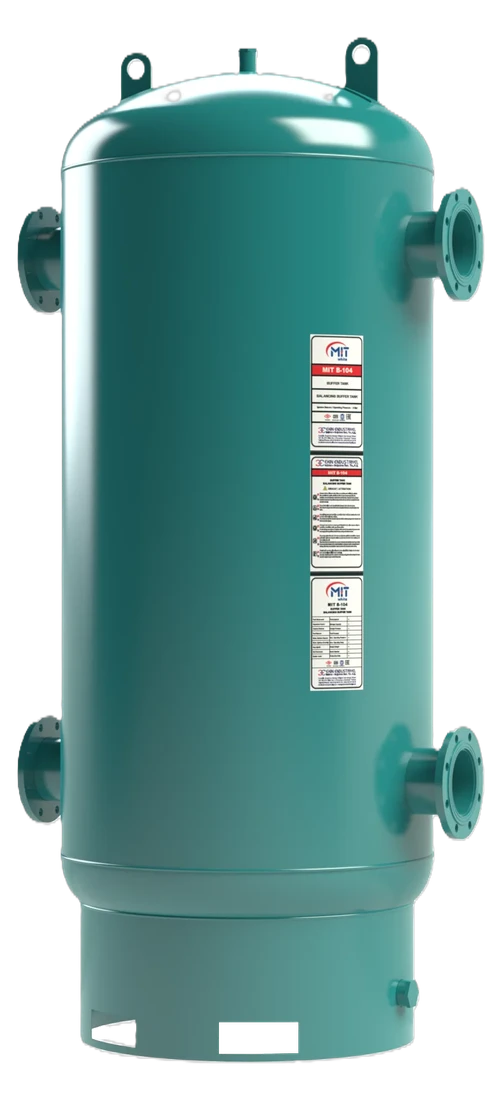
Buffer tanks increase the system's water volume to prevent the boiler or chiller from starting and stopping frequently (short-cycling); this extends equipment life and reduces temperature swings. We supply buffer tanks for heating and cooling circuits, including multi-port models that can also act as a hydraulic separator.
Why it matters
It increases the system's water volume to prevent the heat source or chiller from starting and stopping frequently.
A boiler or chiller starts and stops frequently when it cannot cover the load with too little water volume; a buffer tank breaks this cycle by increasing the system's volume.
Frequent start-stop cycling is the biggest cause of fatigue for compressors and burners; a buffer tank reduces the number of cycles and extends equipment life.
The added water volume makes temperature change more slowly during sudden load swings, improving comfort and process stability.
Multi-port models hydraulically separate the boiler/chiller circuit from the installation circuit, preventing the pumps from affecting each other.
Types
All three increase the system's water volume; what sets them apart is the circuit type and connection layout.
The standard solution for preventing short-cycling in boiler and heat pump circuits; often used together with underfloor heating systems.
Prevents the compressor from cycling on frequently in chiller circuits; plays a critical role especially in systems running at low loads.
Hydraulically separates the boiler/chiller from the installation circuit while also acting as a buffer; preferred in multi-pump systems.
Selection criteria
Selection cannot be made without the first two items. The rest determine the connection layout and fittings.
Volume
Calculated from the heat source's minimum capacity and the system's load profile.
L
Circuit type
Whether it will be used for heating, cooling, or both.
Heating / cooling
Number of connections
A single inlet/outlet, or a multi-port version that also acts as a hydraulic separator.
2-port / multi-port
Operating pressure
Must match the system supply pressure.
bar
Insulation
Determined by the heat loss/gain tolerance.
mm
Connection size and installation location
Inlet/outlet ports and the boiler room layout.
DN size + installation clearance
It's fine if you don't have all of it. We'll fill in the gaps together with you.
Create a quote requestFAQ
The questions we hear most often when quoting buffer tanks.
It is when the heat source starts and stops frequently because of insufficient water volume; every start-stop cycle shows up as mechanical fatigue and lost efficiency in the equipment.
They are often combined in the same shell. The buffer function focuses on adding volume, while the hydraulic separator function decouples the flow of the two circuits from each other; multi-port models provide both.
It is calculated from the heat source's minimum capacity, the system's instantaneous load swings and the desired cycling frequency; we can also give an approximate figure without a site survey.
It is technically possible, but a separate tank is usually preferred; mixing the two circuits in the same tank can make temperature control harder.
No. While our office is on Istanbul's Anatolian side (Ataşehir), we supply and ship across Istanbul's European side, the surrounding provinces and the Marmara region, and Turkey as a whole — covering your equipment end to end, from a single source.
Next step
Share your heat source's capacity and your short-cycling complaint, and let's determine the right buffer tank for your system together.
Related products
Complementary equipment you may need for your project.