Protects equipment life
Overheated oil loses its viscosity and lubrication performance drops. An oil cooler prevents early wear in compressors and hydraulic systems.
Product group · Heat Transfer Products
A heat exchanger that keeps the oil temperature of hydraulic systems, compressors and gearboxes within safe limits. Available in water-cooled, air-cooled and plate types, adaptable to different installation conditions.
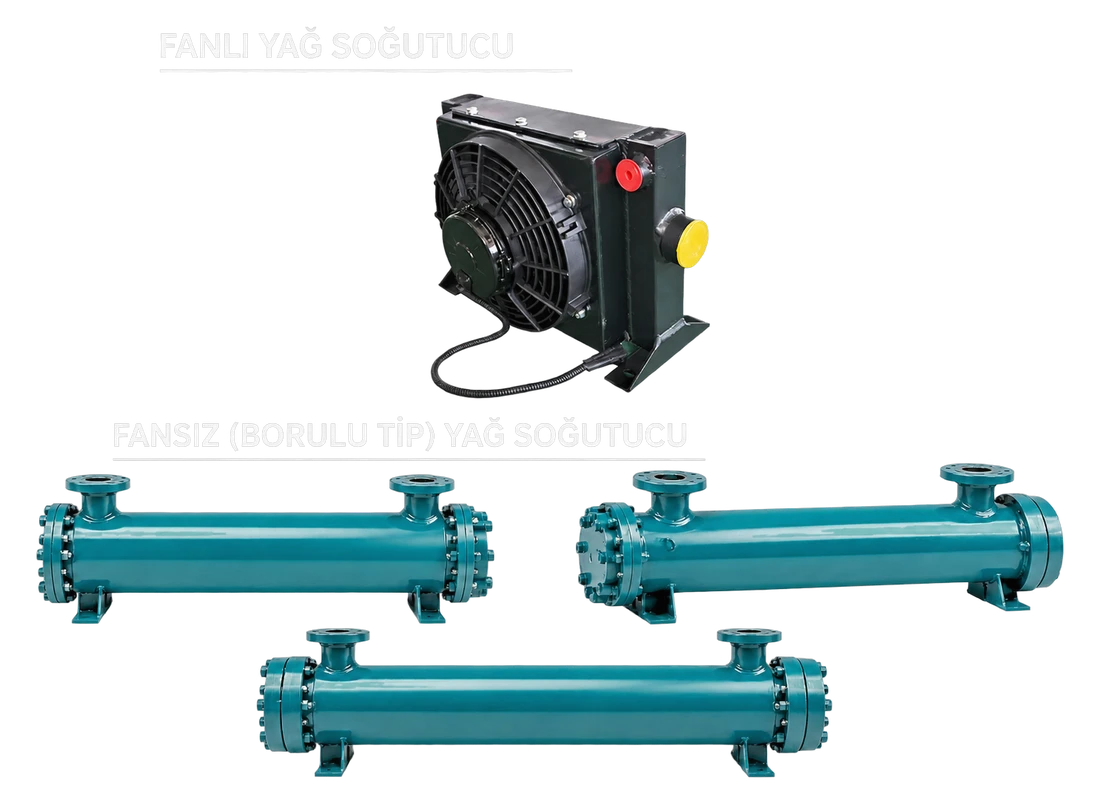
Fan-assisted (air-cooled) and fanless (tube-type) oil cooler options
Why it matters
In hydraulic and mechanical systems, friction and pressure loss heat up the oil. An oil cooler removes this heat, keeping the oil and the equipment at a safe temperature.
Overheated oil loses its viscosity and lubrication performance drops. An oil cooler prevents early wear in compressors and hydraulic systems.
Insufficient oil cooling can cause equipment to shut down automatically on a temperature alarm. A correctly sized oil cooler eliminates this risk.
By choosing a water-cooled or air-cooled type to match the facility's available chilled water source or water constraints, it adapts to different installation conditions.
It is a standard complement to a wide range of equipment, including hydraulic power units, compressors, gearboxes, machine tools and injection molding machines.
Types
All three cool oil; what sets them apart is the medium they reject heat to and the shell design.
A compact, efficient shell-and-tube type connected to an existing chilled water or cooling-tower water source.
A standalone type needing no water source, rejecting the oil's heat directly to outside air with the help of a fan.
A plate design that operates in a smaller volume than a water-sourced shell-and-tube type, for applications with limited space.
Selection criteria
Capacity alone isn't enough. Once the six points below are clear, the choice narrows to a single model.
Cooling capacity
The heat load to be removed from the oil circuit; it directly determines the cooler's size.
kW
Oil type and viscosity
Hydraulic oil, gear oil, etc.; viscosity affects the heat transfer coefficient and pressure loss.
Oil type + viscosity grade
Oil flow rate and temperature
Inlet–outlet temperatures and the flow rate form the basis of the capacity calculation.
l/min + °C
Cooling medium
Whether a water source is available, or an air-cooled type is preferred; this determines the installation and layout plan.
Water / air
Operating pressure
The oil circuit's operating pressure; it determines the tube wall thickness and connection type.
bar
Connection and installation
Flanged, threaded or welded connection; clarified based on integration with the existing equipment and the installation space.
Connection type and size
It's fine if you don't have all of it. We'll fill in the gaps together with you.
Create a quote requestFAQ
The questions we hear most often when quoting oil coolers.
If the facility has a chilled water source (a chiller, cooling-tower water), the water-cooled type is more compact and efficient. If there is no water source, or water consumption isn't wanted, the air-cooled type, which rejects heat to outside air with a fan, is preferred.
It is used to keep oil temperature within safe limits on equipment lubricated or cooled by oil, such as hydraulic power units, compressors, gearboxes, machine tools and injection molding machines.
Oil viscosity changes with temperature and directly affects the heat transfer coefficient. An incorrect viscosity assumption can lead to lower cooling performance than expected.
In applications with limited space, where a water-sourced, compact solution is wanted, a plate oil cooler, which operates in a smaller volume than a shell-and-tube type, can be preferred.
No. While our office is on Istanbul's Anatolian side (Ataşehir), we supply and ship across Istanbul's European side, the surrounding provinces and the Marmara region, and Turkey as a whole — covering your equipment end to end, from a single source.
Next step
Share your fluid type, capacity and operating conditions, and let's work out the right evaporator, condenser or dry cooler together.
Related products
Complementary equipment you may need for your project.