Multiplies the air-side surface area
The fin pack offers a far larger heat transfer surface than a bare tube, achieving much higher capacity within the same volume.
Product group · Heat Transfer Products
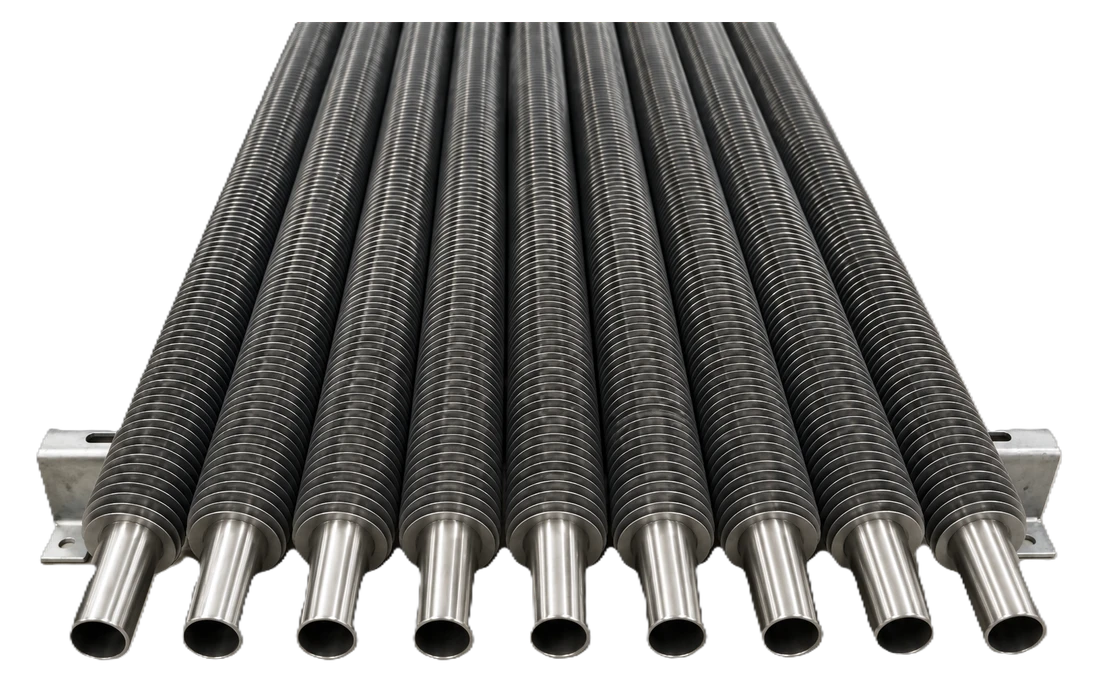
A heat exchanger type that multiplies the air-side heat transfer area with thin metal fins bonded to the tube surface. Used for heating and cooling in HVAC units and industrial processes.
Why it matters
A bare tube surface transfers very little heat to air. Adding fins multiplies the surface area on the same tube many times over — this is the key to air-side heat transfer.
The fin pack offers a far larger heat transfer surface than a bare tube, achieving much higher capacity within the same volume.
Used as the heating/cooling coil inside air handling units, and for air heating, drying and cooling in industrial processes.
Water, glycol and steam each call for a different tube-fin combination. The wrong material choice speeds up corrosion and efficiency loss; the right choice determines service life.
With a single- or multi-circuit design, it adapts to different flow and capacity needs, offering different performance options within the same frame size.
Types
All three work on the same fin + tube principle; what sets them apart is the number of rows and the material choice.
A single-row, economical design for low-to-medium capacity applications with a limited temperature difference.
For applications needing high capacity or a large temperature difference, thermal performance is raised by increasing the number of rows.
A durable option used instead of a standard copper/aluminum construction in corrosive environments such as coastal locations, high humidity or chemical vapor exposure.
Selection criteria
Capacity alone isn't enough. Once the six points below are clear, the choice narrows to a single model.
Heating / cooling capacity
Air flow rate together with the inlet–outlet temperatures determines capacity. An undersized coil can't reach the target temperature.
kW and air flow rate (m³/h)
Fluid type and regime
Water, a glycol mixture or steam — each requires a different tube diameter, fin spacing and circuit design.
Water / glycol / steam
Temperature and pressure conditions
High pressure and temperature in steam applications; operating pressure changes the tube wall thickness and material class.
°C and bar
Air flow rate and face velocity
Fin spacing and row count are optimized against face velocity. Getting it wrong causes either excess pressure loss or insufficient heat transfer.
m³/h and m/s
Tube and fin material
Copper, aluminum, stainless or a special alloy — chosen according to the fluid chemistry and how corrosive the environment is.
Copper / aluminum / stainless
Connection size and mounting orientation
The entry clearance into the duct or unit casing, the connection size, and the mounting orientation (horizontal/vertical) need to be clear from the start.
DN sizes + mounting orientation
It's fine if you don't have all of it. We'll fill in the gaps together with you.
Create a quote requestFAQ
The questions we hear most often when quoting finned tube coils.
Both use the same finned tube construction. "Coil" (batarya) usually refers to the type mounted inside an air handling unit, designed for a single regime (heating, cooling or steam), while "finned tube coil" (serpantin) is the broader term covering finned tube exchangers across process and HVAC applications.
A single row is enough for low-capacity applications with a limited temperature difference. For high capacity or a large temperature difference, the number of rows is increased to keep air resistance reasonable.
A tighter fin spacing gives more surface area but raises pressure loss and makes the coil more sensitive to fouling. A wider spacing is preferred in dusty environments and outside-air applications; a tight spacing improves efficiency in clean indoor settings.
In coastal locations, high humidity or environments with chemical vapors, a standard copper/aluminum construction corrodes quickly. In these conditions, stainless tubing, epoxy-coated fins or a special alloy are used instead.
No. While our office is on Istanbul's Anatolian side (Ataşehir), we supply and ship across Istanbul's European side, the surrounding provinces and the Marmara region, and Turkey as a whole — covering your equipment end to end, from a single source.
Next step
Share the air flow rate, temperature range and fluid type, and let's work out the right coil together.
Related products
Complementary equipment you may need for your project.