The heat-absorbing side of the refrigeration cycle
The refrigerant vaporizes inside the tube bundle, drawing heat from the surrounding water or glycol mixture; this cooled fluid is then distributed through the facility.
Product group · Heat Transfer Products
The first main heat exchanger in the refrigeration cycle, drawing heat from the surroundings by vaporizing the refrigerant. It is the heart of chillers and industrial cooling plants, available in DX, flooded and dual-circuit types.
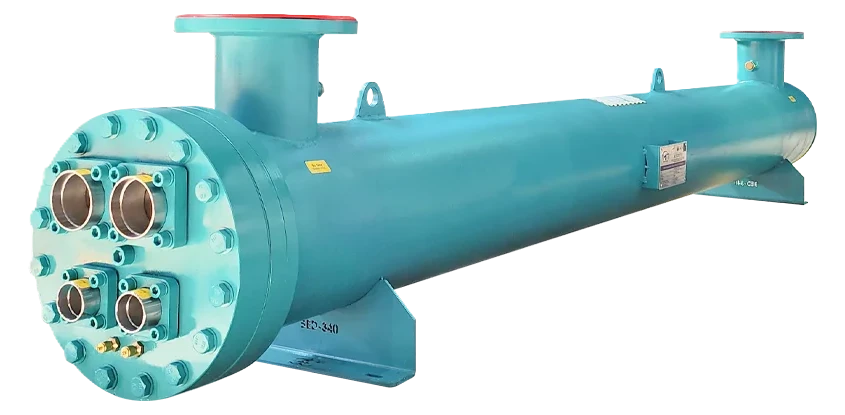
Counter-flow operation · refrigerant on the left, cooled fluid on the right
Why it matters
This is the heat-absorbing side of the refrigeration cycle. Without an evaporator, a chiller or cooling plant can't cool water or air.
The refrigerant vaporizes inside the tube bundle, drawing heat from the surrounding water or glycol mixture; this cooled fluid is then distributed through the facility.
Different refrigerants such as R134a, R410A and ammonia call for different pressure classes and materials. A mismatch can lead to lost efficiency and a safety risk.
The evaporator's heat transfer capacity and approach temperature directly affect the entire cooling plant's COP (efficiency).
With a dual-circuit design, one circuit can keep running while the other is under maintenance — preventing downtime on critical cooling lines.
Types
All three draw heat by vaporizing the refrigerant; what sets them apart is how the fluid circulates and the number of circuits.
The standard type for medium and large-capacity chiller systems, where the refrigerant vaporizes directly inside the tube.
The tube bundle is fully submerged in liquid refrigerant, giving a higher heat transfer coefficient and a lower approach temperature.
Has two refrigerant circuits that can run independently of each other; one stays in service while the other is under maintenance, keeping operation uninterrupted.
Selection criteria
Capacity alone isn't enough. Once the six points below are clear, the choice narrows to a single model.
Cooling capacity
The heat load to be removed; it directly determines the evaporator's size and tube bundle area.
kW
Refrigerant type
R134a, R410A, ammonia, etc.; each requires a different material and pressure class.
Refrigerant name
Evaporation temperature and pressure
Operating pressure determines the tube wall thickness and material class.
°C and bar
Cooled fluid and flow rate
Water, a glycol mixture or a process fluid; the flow rate and inlet–outlet temperatures determine capacity.
m³/h + °C
Circuit configuration
Whether a single circuit or a dual circuit for redundancy; determined by the tolerance for downtime.
Single / dual circuit
Connection and installation
Flanged, threaded or welded connection; clarified based on integration with the existing line and the installation space.
Connection type and size
It's fine if you don't have all of it. We'll fill in the gaps together with you.
Create a quote requestFAQ
The questions we hear most often when quoting evaporators.
In a DX (direct-expansion) evaporator, the refrigerant vaporizes inside the tubes. In a flooded type, the tubes are fully submerged in liquid refrigerant; this gives a higher heat transfer coefficient but requires a larger refrigerant charge.
In applications where redundancy is needed, or the system must not stop entirely while one circuit is under maintenance, an evaporator with two independent refrigerant circuits is preferred.
The flow rate of the fluid to be cooled, its inlet-outlet temperatures, and the refrigerant's evaporation temperature are evaluated together. Your chiller manufacturer's or project specification's data form the basis for this calculation.
If the fluid being cooled is water, copper tube is generally sufficient. For seawater or fluids containing aggressive chemicals, a stainless steel or titanium tube bundle is preferred.
No. While our office is on Istanbul's Anatolian side (Ataşehir), we supply and ship across Istanbul's European side, the surrounding provinces and the Marmara region, and Turkey as a whole — covering your equipment end to end, from a single source.
Next step
Share your fluid type, capacity and operating conditions, and let's work out the right evaporator, condenser or dry cooler together.
Related products
Complementary equipment you may need for your project.