No gasket, so the risk of leaks disappears
The plates are brazed directly with copper or nickel. The leak risk that comes from a gasket aging or hardening simply doesn't exist in the brazed type.
Product group · Heat Transfer Products
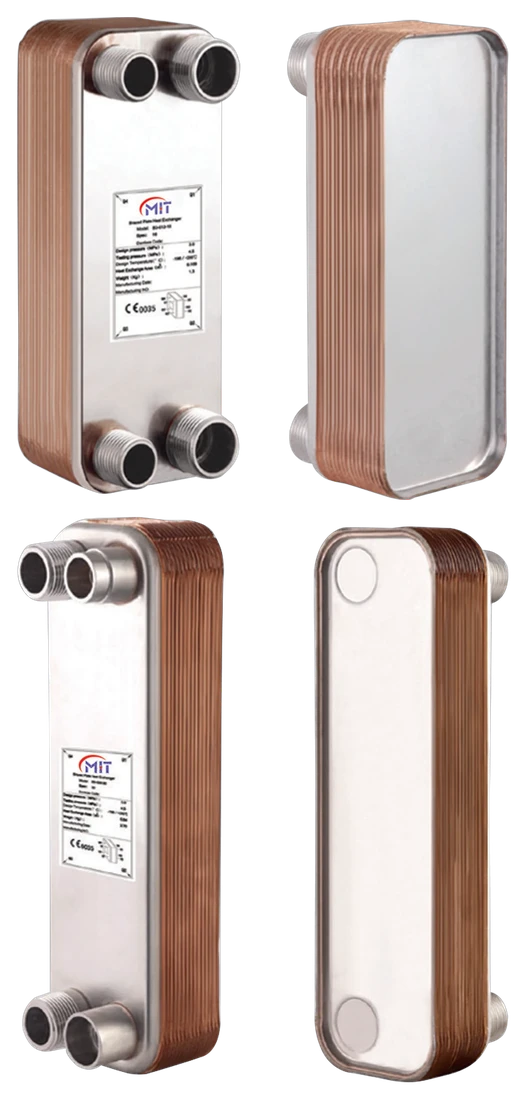
A family of compact heat exchangers whose plates are joined directly with copper or nickel brazing, with no gaskets. High-pressure-rated and small in volume — the standard solution for cooling, heat pump and VRF/chiller circuits.
Why it matters
With no gasket between the plates, the risk of leaks disappears and the pack fits into a much smaller volume. It is an essential part of cooling circuits and compact heating lines.
The plates are brazed directly with copper or nickel. The leak risk that comes from a gasket aging or hardening simply doesn't exist in the brazed type.
With no frame or gasket margin to allow for, a noticeably smaller body is enough for the same capacity as the gasketed type. This is an advantage in tight mechanical rooms and OEM units.
The brazed joint withstands far higher operating pressure than the gasketed type. It is a suitable construction for the high-side pressure of refrigerant circuits.
It is the heat exchanger type most commonly used in chiller evaporator/condenser circuits, VRF systems and heat pumps, suited to heat exchange between a fluid and a refrigerant gas.
The plate geometry works on the same counter-flow principle as the gasketed type, reaching a low approach temperature for high thermal efficiency.
It is lighter and more economical than the shell-and-tube type. It is the preferred choice for clean fluids and fixed installations where capacity won't grow.
Types
All three are brazed and gasket-free; what sets them apart is the braze material and the frame/mounting design.
The most common and economical type, with stainless steel plates brazed together with copper. Suitable for water/water heating-cooling circuits and most split/chiller applications.
A nickel-brazed type used with ammonia (NH3), which reacts with copper, and other aggressive process fluids. Also preferred for food and chemical process lines.
A type in which the brazed plate pack is held inside a stainless mounting bracket, reinforced against vibration and repeated pressure cycling. Built for OEM chiller and heat pump units.
Selection criteria
Once the eight points below are clear, the choice narrows to a single model. We calculate whichever of these you don't already have.
Thermal capacity
The amount of energy to be transferred. Oversizing raises the initial investment, undersizing costs comfort.
kW or kcal/h
Temperature regime
Inlet–outlet temperatures of the primary and secondary circuits. This directly determines the approach temperature and the number of plates.
e.g. 90/70 – 10/60 °C
Flow rate
The amount of fluid passing through each circuit. The number of plate channels and the connection diameter follow from this.
m³/h or l/s
Allowable pressure loss
Affects pump selection. Keep it low and the exchanger grows larger; keep it high and pump energy use rises.
kPa (typically 20–50)
Operating and design pressure
The PN class, based on building height and static pressure. In high-rise buildings this can be decisive on its own.
PN10 / PN16 / PN25
Fluid type and fouling
Water, a glycol mixture, steam, seawater or a process liquid. A fouling factor is added to the capacity as a margin.
Fluid + fouling margin
Plate and braze material
The plate (AISI 316) determines corrosion resistance; the braze material determines chemical compatibility. With ammonia and some refrigerants, copper braze isn't suitable and nickel braze is required.
AISI 316 · Cu / Ni braze
Connection type and size
Compatibility with the existing installation. Flanged, threaded or welded, along with mounting clearance and service margin.
DN size + connection type
It's fine if you don't have all of it. We'll fill in the gaps together with you.
Create a quote requestFAQ
The questions we hear most often when quoting brazed heat exchangers.
There is no gasket thickness or frame to hold a gasket between the plates; the plates are brazed directly with copper or nickel. The same thermal capacity fits into a much smaller body.
Copper-brazed is sufficient for water/water, heating and most cooling circuits. For refrigerants that react with copper, such as ammonia (NH3), or aggressive process chemicals, the nickel-brazed type is required.
The body can't be opened, so mechanical cleaning isn't possible; it is cleaned with chemical circulation (CIP) inside the circuit. For fluids with a high fouling risk, a gasketed or shell-and-tube type should be chosen from the start.
It is economical and compact at small and medium capacities (typically up to a few hundred kW). As capacity grows, or if later expansion is needed, the gasketed plate type is the better move.
No. While our office is on Istanbul's Anatolian side (Ataşehir), we supply and ship across Istanbul's European side, the surrounding provinces and the Marmara region, and Turkey as a whole — covering your equipment end to end, from a single source.
Next step
Write to us with what you have, and we'll ask about the rest. Your quote will be ready within a business day.
Related products
Complementary equipment you may need for your project.