Withstands dirty and particle-laden fluids
The flow path inside the tubes is far wider than in a plate type, giving it noticeably more tolerance against clogging. Preferred for process water, waste heat sources and dirty fluids.
Product group · Heat Transfer Products
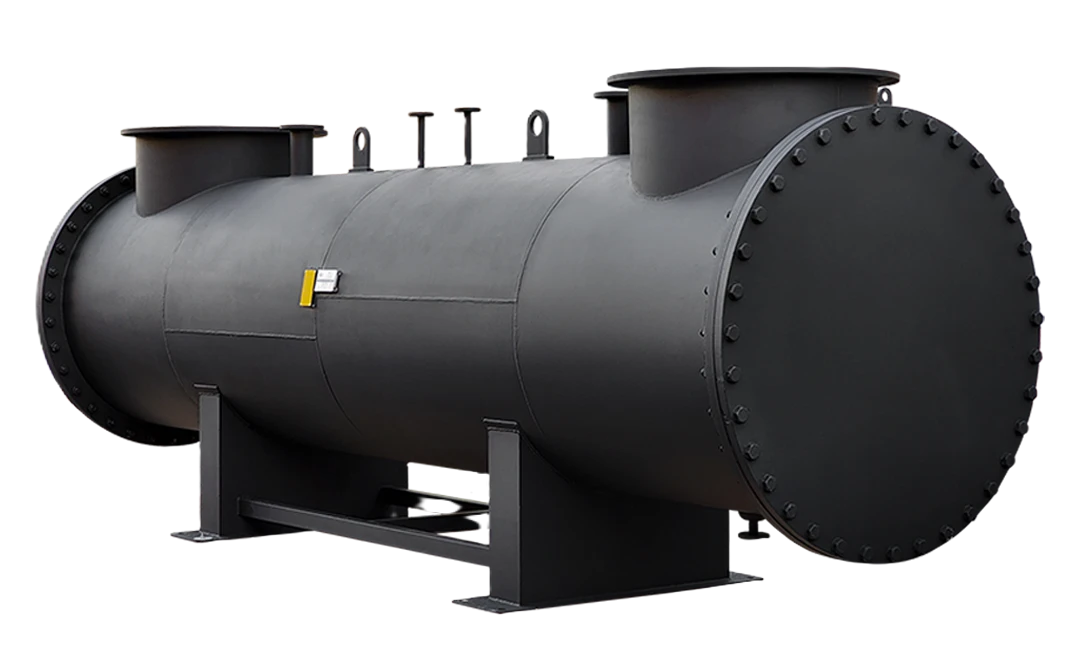
A family of heat exchangers in which a bundle of tubes sits inside a cylindrical shell, built to withstand dirty fluids and high pressure/temperature. The choice for steam, process and high-pressure lines.
Why it matters
Plate types fall short when working with dirty, particle-laden or high-temperature/pressure fluids. A shell-and-tube exchanger is a rugged alternative built for these conditions.
The flow path inside the tubes is far wider than in a plate type, giving it noticeably more tolerance against clogging. Preferred for process water, waste heat sources and dirty fluids.
The shell and tube bundle can be designed for high pressure classes and steam applications — the classic solution for boiler room and process steam lines.
There is no intermediate material carrying a temperature limit, such as a gasket or braze. It can be used safely on high-temperature steam and thermal oil lines.
In U-tube and floating head types, the tube bundle can be pulled out of the shell for mechanical cleaning or replacement — meaning a long service life in the field.
For applications needing high capacity and a large heat transfer area, the shell-and-tube design becomes more cost-effective than plate alternatives.
U-tube and floating head constructions absorb the expansion caused by a large temperature difference between the two fluids without damaging the shell.
Types
All three work on the tube bundle + shell principle; what sets them apart is how the tube bundle is fixed and how it handles expansion.
The tube bundle is fixed to the shell at both ends. The most economical solution for applications with a low temperature difference that work with clean fluids.
The tube bundle is bent into a U shape and connected to a single tube sheet, which lets it absorb thermal expansion on its own. The bundle can be pulled out and cleaned.
One end is fixed while the other moves freely inside the shell. The tube bundle can be fully removed and cleaned from both sides — designed for the dirtiest, harshest conditions.
Selection criteria
Once the eight points below are clear, the choice narrows to a single model. We calculate whichever of these you don't already have.
Thermal capacity
The amount of energy to be transferred. Oversizing raises the initial investment, undersizing costs comfort.
kW or kcal/h
Temperature regime
Inlet–outlet temperatures of the primary and secondary circuits. This directly determines the approach temperature and the number of plates.
e.g. 90/70 – 10/60 °C
Flow rate
The amount of fluid passing through each circuit. The number of plate channels and the connection diameter follow from this.
m³/h or l/s
Allowable pressure loss
Affects pump selection. Keep it low and the exchanger grows larger; keep it high and pump energy use rises.
kPa (typically 20–50)
Operating and design pressure
The PN class, based on building height and static pressure. In high-rise buildings this can be decisive on its own.
PN10 / PN16 / PN25
Fluid type and fouling
Water, a glycol mixture, steam, seawater or a process liquid. A fouling factor is added to the capacity as a margin.
Fluid + fouling margin
Shell and tube material
Determines corrosion and temperature resistance. Carbon steel is an economical solution; stainless or a special alloy is needed for aggressive or high-temperature fluids.
Carbon steel / AISI 316 / special alloy
Connection type and size
Compatibility with the existing installation. Flanged, threaded or welded, along with mounting clearance and service margin.
DN size + connection type
It's fine if you don't have all of it. We'll fill in the gaps together with you.
Create a quote requestFAQ
The questions we hear most often when quoting shell-and-tube heat exchangers.
A shell-and-tube type is preferred when the fluid is dirty or contains particles, when the operating pressure/temperature exceeds the limit of a plate type, or when working with steam.
U-tube is preferred when there is a large temperature difference between the two fluids and thermal expansion matters. If the temperature difference is low and the fluid is clean, the more economical fixed tube sheet type is sufficient.
The floating head type is preferred for very dirty or fouling-prone fluids, where the tube bundle needs to be fully removed and cleaned from both ends.
Yes. One of the biggest advantages of a shell-and-tube exchanger is that the tube bundle alone can be removed and cleaned, or replaced with a new one, without changing the shell.
No. While our office is on Istanbul's Anatolian side (Ataşehir), we supply and ship across Istanbul's European side, the surrounding provinces and the Marmara region, and Turkey as a whole — covering your equipment end to end, from a single source.
Next step
Write to us with what you have, and we'll ask about the rest. Your quote will be ready within a business day.
Related products
Complementary equipment you may need for your project.