The core element of comfort cooling
It draws heat from air into chilled water from the chiller or into the refrigerant directly, forming the cooling side of air handling units and fan coil systems.
Product group · Heat Transfer Products
The cooling and dehumidification element of air handling units, drawing heat from air into chilled water or a direct-expansion refrigerant. Used from comfort cooling to industrial humidity control.
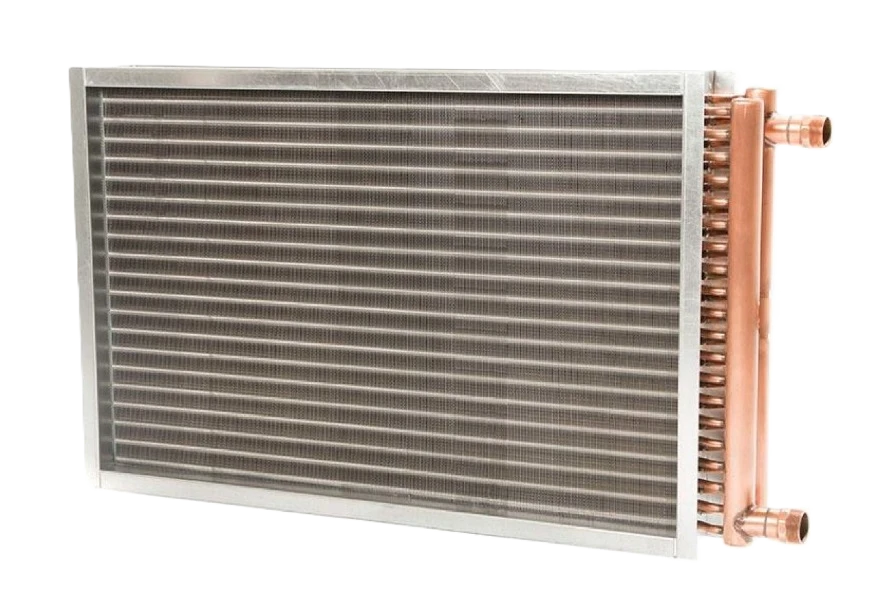
Cooling coil · air flows vertically, cold fluid passes horizontally
Why it matters
When the air passing through an air handling unit needs to be cooled and dehumidified, that job falls to the finned tube coil, which brings the air into contact with a cold surface.
It draws heat from air into chilled water from the chiller or into the refrigerant directly, forming the cooling side of air handling units and fan coil systems.
When air is cooled below its dew point, the moisture it carries condenses out. A cooling coil lowers temperature and controls relative humidity at the same time.
It can be designed for either a chilled water circuit or a direct-expansion (DX) refrigerant circuit, selected to match the existing cooling infrastructure.
Condensed moisture collects in a drip tray and is removed through a trapped line; drainage that isn't properly designed creates a risk of overflow and mold.
Types
All three cool air; what sets them apart is the refrigerant type and the dehumidification capacity.
The standard element of central cooling systems, running on chilled water from the chiller (typically 6-12 °C).
A type widely used in split and VRF systems, where the refrigerant vaporizes directly in the tubes.
Designed with more rows and tighter fin spacing to increase the air's contact time with the cold surface, for applications needing intensive humidity control.
Selection criteria
Capacity alone isn't enough. Once the six points below are clear, the choice narrows to a single model.
Cooling capacity
Air flow rate together with the inlet–outlet temperatures determines capacity. An undersized coil can't reach the target temperature and humidity.
kW and air flow rate (m³/h)
Fluid type
Chilled water (typically 6-12 °C) or a DX refrigerant; each calls for a different circuit and connection design.
Chilled water / DX (R410A etc.)
Dehumidification / dew point target
The target relative humidity and outlet temperature determine the number of rows and the fin spacing.
% relative humidity + °C dew point
Air flow rate and face velocity
Fin spacing and row count are optimized against face velocity. Getting it wrong causes either excess pressure loss or insufficient heat transfer.
m³/h and m/s
Fin coating and ambient conditions
Coastal locations, high humidity or dirty environments call for a hydrophilic/epoxy coating or stainless steel.
Standard / hydrophilic / epoxy
Condensate drainage
The drip tray size and drain line slope are designed to match the amount of condensate generated.
Drain line diameter and slope
It's fine if you don't have all of it. We'll fill in the gaps together with you.
Create a quote requestFAQ
The questions we hear most often when quoting cooling coils.
As the air is cooled, the moisture that condenses is collected in a drip tray beneath the coil and removed through a trapped drain line. The tray and drain line slope are designed together with the capacity.
In a chilled water coil, chilled water from the cooling plant (typically 6-12 °C) circulates through the circuit. In a DX coil, the refrigerant itself vaporizes directly in the tubes to draw heat; this is common in split/VRF systems, and the number of circuits is calculated separately.
Yes. In applications needing intensive dehumidification, more rows and tighter fin spacing keep air in contact with the cold surface for longer; this raises air resistance, which directly affects fan selection.
Standard aluminum fins can corrode quickly in salty air and dirty environments. In these conditions, hydrophilic or epoxy-coated fins are preferred, and in some cases stainless steel.
No. While our office is on Istanbul's Anatolian side (Ataşehir), we supply and ship across Istanbul's European side, the surrounding provinces and the Marmara region, and Turkey as a whole — covering your equipment end to end, from a single source.
Next step
Share the air flow rate, temperature range and fluid type, and let's work out the right coil together.
Related products
Complementary equipment you may need for your project.