A common solution for comfort and process heating
In settings as different as offices, shopping malls and production facilities, the same heating coil principle is used to bring air up to the required temperature.
Product group · Heat Transfer Products
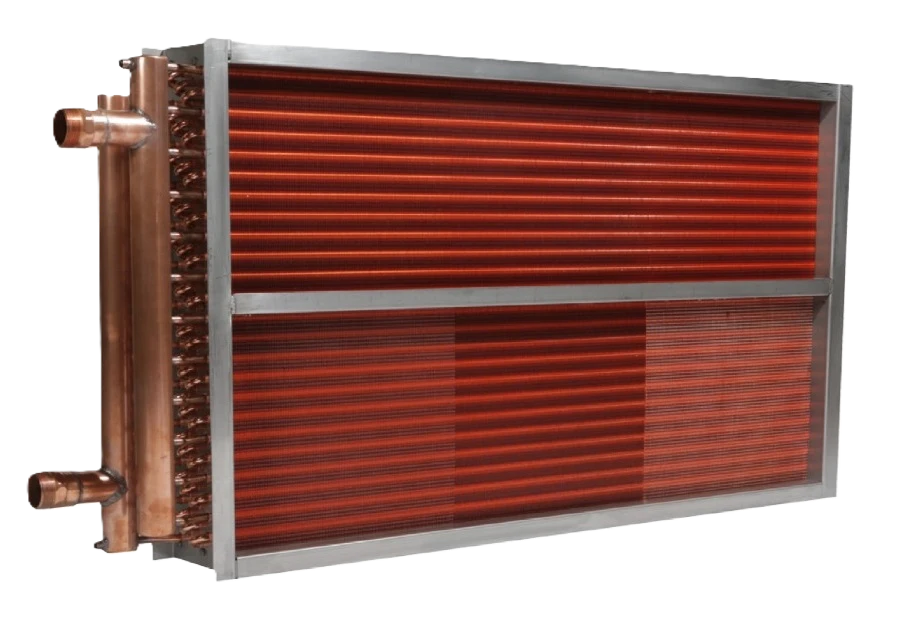
The heating element of air handling units and duct systems, transferring heat from hot water to air through a finned tube bundle. Covers a wide range of applications, from comfort heating to outside-air pre-heat.
Why it matters
When the air passing through an air handling unit needs to be heated, that job falls to the finned tube coil that transfers heat from hot water to the air.
In settings as different as offices, shopping malls and production facilities, the same heating coil principle is used to bring air up to the required temperature.
In fresh-air units, it pre-heats outside air before it is mixed in, protecting comfort while reducing the load on the main heating coil.
It connects directly to the hot water circuit coming from the boiler room; the number of rows and the tube-fin combination are chosen to match the circuit temperature.
For heating coils in contact with outside air, freeze protection (an antifreeze circuit, a drain-down arrangement) is designed in from the start, cutting the risk of failure in winter months.
Types
All three run on hot water; what sets them apart is the operating temperature and whether freeze protection is needed.
The most common type for comfort and process heating, running on the standard hot water circuit from the boiler room (typically 80/60 °C).
Built with materials suited to high pressure and temperature, for central heating systems running a closed high-temperature water circuit (110-130 °C).
A type designed primarily for freeze protection, pre-heating outside air before it is mixed in fresh-air units.
Selection criteria
Capacity alone isn't enough. Once the six points below are clear, the choice narrows to a single model.
Heating capacity
Air flow rate together with the inlet–outlet temperatures determines capacity. An undersized coil can't reach the target temperature.
kW and air flow rate (m³/h)
Water inlet/outlet temperature
The temperature regime of the boiler or central circuit; it directly determines the number of rows and the tube-fin combination.
e.g. 80/60 °C or 110/90 °C
Operating and design pressure
The circuit's operating pressure determines the tube wall thickness and connection class.
PN6 / PN10 / PN16
Air flow rate and face velocity
Fin spacing and row count are optimized against face velocity. Getting it wrong causes either excess pressure loss or insufficient heat transfer.
m³/h and m/s
Freezing risk
If there is contact with outside air, an antifreeze circuit, low-temperature alarm and drain-down arrangement need to be planned from the start.
Yes / no + ambient temperature
Connection size and mounting orientation
The entry clearance into the duct or unit casing, the connection size, and the mounting orientation (horizontal/vertical) need to be clear from the start.
DN sizes + mounting orientation
It's fine if you don't have all of it. We'll fill in the gaps together with you.
Create a quote requestFAQ
The questions we hear most often when quoting heating coils.
The number of rows is determined by the capacity needed together with the water inlet-outlet temperature difference. At a low temperature difference (for example from a condensing boiler outlet) more rows are needed; at a high temperature difference, fewer rows may be enough.
For heating coils exposed to outside air, the risk of freezing must be taken seriously: measures such as antifreeze circulation, a low-temperature alarm, and automatic drain-down if the circuit goes offline are planned at the design stage.
In central heating systems running a closed high-temperature water circuit (110-130 °C), a coil built with material and a pressure class suited to that high temperature is used instead of a standard low-pressure coil.
No. A heating coil runs on hot water, while a steam coil draws on the latent heat of condensing steam and needs condensate drainage. The two call for different tube materials and circuit designs.
No. While our office is on Istanbul's Anatolian side (Ataşehir), we supply and ship across Istanbul's European side, the surrounding provinces and the Marmara region, and Turkey as a whole — covering your equipment end to end, from a single source.
Next step
Share the air flow rate, temperature range and fluid type, and let's work out the right coil together.
Related products
Complementary equipment you may need for your project.