Delivers high capacity in a small surface area
The condensing heat of steam is far higher than that of water/glycol; the same air-heating capacity can be reached with less surface area.
Product group · Heat Transfer Products
The finned tube element of high-capacity heating applications, transferring the latent heat steam gives up as it condenses into air. Correctly designed condensate drainage and freeze protection deliver high efficiency and a long service life.
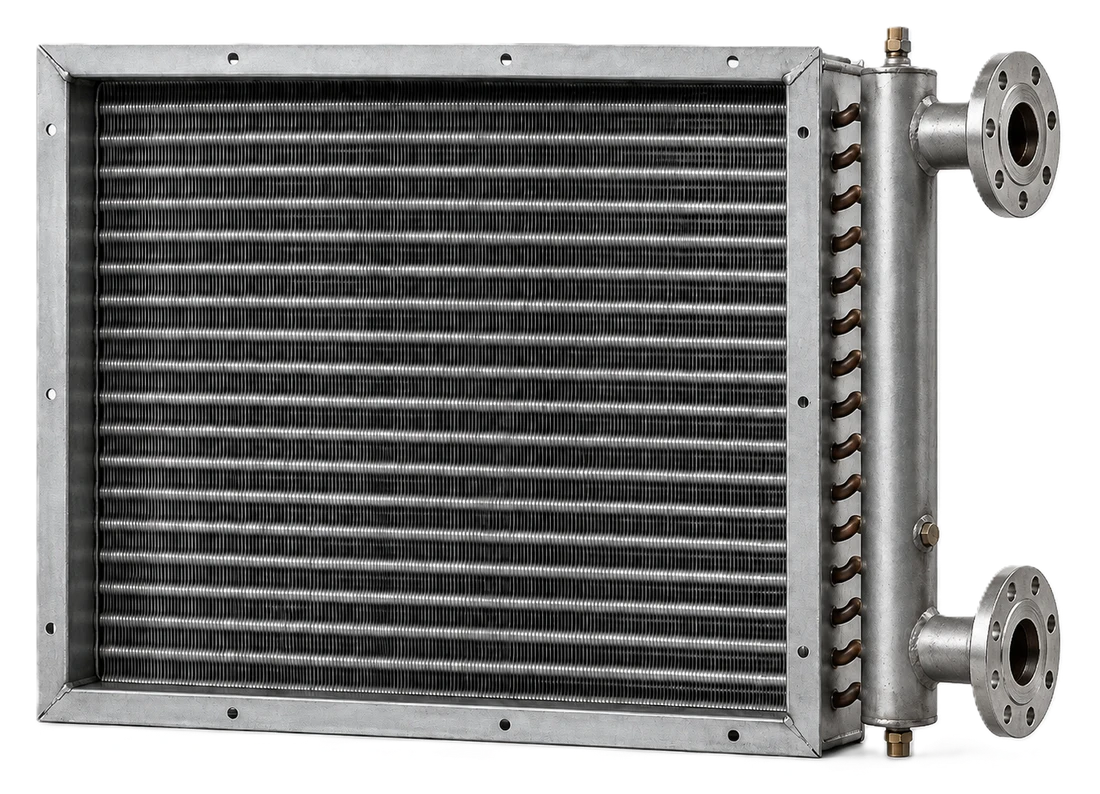
Steam coil · air flows vertically, steam passes horizontally, works together with condensate drainage
Why it matters
As it condenses, steam gives up far more heat than water/glycol. A steam coil transfers this latent heat into air, delivering high-capacity heating.
The condensing heat of steam is far higher than that of water/glycol; the same air-heating capacity can be reached with less surface area.
In boiler rooms producing process steam, air heating can be fed directly from the same steam line, with no need to build a separate water circuit.
Condensed steam (condensate) can be drained through a steam trap and returned to the boiler room, saving both fuel and water.
In systems exposed to outside air, the risk of condensate freezing is addressed in advance with a non-freeze circuit design and automatic drainage.
Types
All three run on steam; what sets them apart is the need for freeze protection and the operating pressure.
A standard type suited to a typical pressure range of 2-6 bar(g), used indoors or on lines with no risk of freezing.
A special circuit design that prevents condensate from freezing and bursting the tubes on lines in contact with outside air, where the steam supply can be interrupted.
Built with thicker steel tube and connections rated for a high pressure class, for applications where the process needs more than 10 bar(g).
Selection criteria
Capacity alone isn't enough. Once the six points below are clear, the choice narrows to a single model.
Heating capacity
Air flow rate together with the inlet–outlet temperatures determines capacity. An undersized coil can't reach the target temperature.
kW and air flow rate (m³/h)
Steam pressure
Operating pressure determines the tube wall thickness, material class and steam trap selection.
Typically 2–10 bar(g)
Condensate drainage
The steam trap type and condensate line design ensure the condensed steam is removed efficiently.
Steam trap type + line diameter
Freezing risk
If there is contact with outside air, a non-freeze circuit design, automatic drainage and a low-temperature alarm need to be planned.
Yes / no + ambient temperature
Air flow rate and face velocity
Fin spacing and row count are optimized against face velocity. Getting it wrong causes either excess pressure loss or insufficient heat transfer.
m³/h and m/s
Connection size and mounting orientation
The entry clearance into the duct or unit casing, the connection size, and the mounting orientation (horizontal/vertical) need to be clear from the start.
DN sizes + mounting orientation
It's fine if you don't have all of it. We'll fill in the gaps together with you.
Create a quote requestFAQ
The questions we hear most often when quoting steam coils.
As steam gives up its heat and condenses, it turns into condensate. A steam trap prevents condensate from accumulating inside the coil, draining off only the condensed water while keeping live steam from escaping.
Yes, especially in systems exposed to outside air where the steam supply can be interrupted — condensate can freeze and burst the tubes. A non-freeze circuit design and automatic drainage are recommended against this risk.
Steam runs at a higher temperature and generally higher pressure than water/glycol. For this reason, thicker steel tube and steam-rated connection fittings are generally used.
Typical industrial applications run in the 2-10 bar(g) range; custom designs at higher pressure are also possible depending on process needs. The pressure class determines the tube wall thickness and the gasket/connection choice.
No. While our office is on Istanbul's Anatolian side (Ataşehir), we supply and ship across Istanbul's European side, the surrounding provinces and the Marmara region, and Turkey as a whole — covering your equipment end to end, from a single source.
Next step
Share the air flow rate, temperature range and fluid type, and let's work out the right coil together.
Related products
Complementary equipment you may need for your project.